
- Why Draw Matters More at Windsor Than at Most UK Flat Tracks
- Pace Bias First: The Statistic That Overrides Stall Numbers
- 5 Furlongs: Where Stall 4 Pays +94 Points of LSP
- 6 Furlongs: A Slight High-Draw Edge, But Don't Overbet It
- 1 Mile and Beyond: Draw Weakens, Jockeyship Strengthens
- How Going Changes the Draw: Soft vs Good
- How to Read Draw-Bias Tables Without Overfitting
- Practical Rules: When to Act on the Draw, When to Ignore It
Why Draw Matters More at Windsor Than at Most UK Flat Tracks
At most British flat courses, the draw is a minor consideration. You might note it, factor it in loosely, and move on to form, class and going. At Windsor, that approach will cost you. The figure-of-eight layout — one of only two in the United Kingdom, shared with Fontwell Park, though Fontwell runs jumps rather than flat racing — creates a set of physical conditions that make starting position genuinely consequential. The way the track crosses itself, the camber changes at the crossover, the short home straight and the narrowing on the bends all conspire to produce draw-bias patterns that are more pronounced than at conventionally shaped courses.
Draw bias at Windsor is not a single number. It changes by distance, by going and by field size. A stall that offers a clear advantage at five furlongs may be neutral at a mile and irrelevant at a mile and two furlongs. Soft ground amplifies biases that barely register on good going. And field size acts as a multiplier — a draw disadvantage that matters in a field of twelve may mean nothing in a field of six, because there is more room to manoeuvre. The bettor who treats Windsor draw bias as a fixed “high is good, low is bad” rule will be right some of the time and wrong often enough to wipe out any edge.
This article breaks down the stall data by distance, overlays the effect of going conditions and offers a framework for reading draw-bias tables without falling into the trap of overfitting. The data referenced here covers a five-year period from 2021 to 2025, drawn primarily from OLBG’s HorseRaceBase dataset and DrawBias.com, supplemented by analysis from specialist racing sites. Five years gives a reasonable sample — long enough to smooth out individual-race noise, short enough to reflect current track conditions and race programming.
Before looking at specific stalls, though, there is a bigger number that needs to be addressed first. It is the one that sits above draw bias in the hierarchy of Windsor betting factors, and it is the one that most casual analyses of the draw ignore entirely.
Pace Bias First: The Statistic That Overrides Stall Numbers
The single most important number in Windsor race analysis is not a stall position. It is the pace bias. Across all distances at Windsor, horses that race on or near the pace win at approximately four times the rate of those ridden with hold-up tactics, according to analysis from HorseRacingBettingSites.co.uk. That ratio holds from five furlongs right through to a mile and two furlongs. It is one of the most lopsided pace biases in British flat racing, and it exists because of the course’s physical structure.
The tight bends and figure-of-eight configuration are the primary cause. Although the home straight at Windsor is close to five furlongs — longer than at many tracks — the layout punishes hold-up horses in a different way. A horse coming from the back of the field needs to begin its run on the round course section, often while still navigating the bends or the crossover — where the camber changes direction — without losing balance or momentum. The energy spent accelerating through these sections is energy that is not available for the finishing effort, even though the straight itself is generous. Very few horses manage this transition well. The ones that do tend to be unusually talented, and their wins at Windsor often come in spite of the track rather than because of it.
Why does this matter for draw-bias analysis? Because draw data at Windsor is contaminated by pace style. A stall that appears profitable over a five-year sample may simply be the stall that naturally produces more front-runners — horses that break well from that gate, secure the rail early and race prominently. If you stripped out pace style and looked only at draw, the bias numbers would change. In practice, the two are intertwined and inseparable, but the bettor should always ask: is this horse likely to be on the pace? If the answer is yes, the draw becomes a secondary factor. If the answer is no, even the best draw in the world may not save it at Windsor.
There is a practical hierarchy here. First, assess the likely pace scenario — how many horses in the race want to lead or sit close? Second, check the draw in the context of that pace scenario. A horse drawn low in a race with strong early speed from the stalls around it will be squeezed for position, which negates any theoretical draw advantage. A horse drawn high in a race with no pace pressure can drift across to the rail and make its own running from a position that the draw tables say is unfavourable. Context shapes the data, and at Windsor, the context starts with pace.
5 Furlongs: Where Stall 4 Pays +94 Points of LSP
The five-furlong distance at Windsor produces the most dramatic draw-bias figures on the course. Over the five-year period from 2021 to 2025, stall 4 has returned a level stakes profit of +94.38 points — comfortably the highest single-stall figure at any distance at Windsor, according to OLBG’s HorseRaceBase data. That number is striking, but it needs context before you start backing every horse drawn in stall 4 over five furlongs.
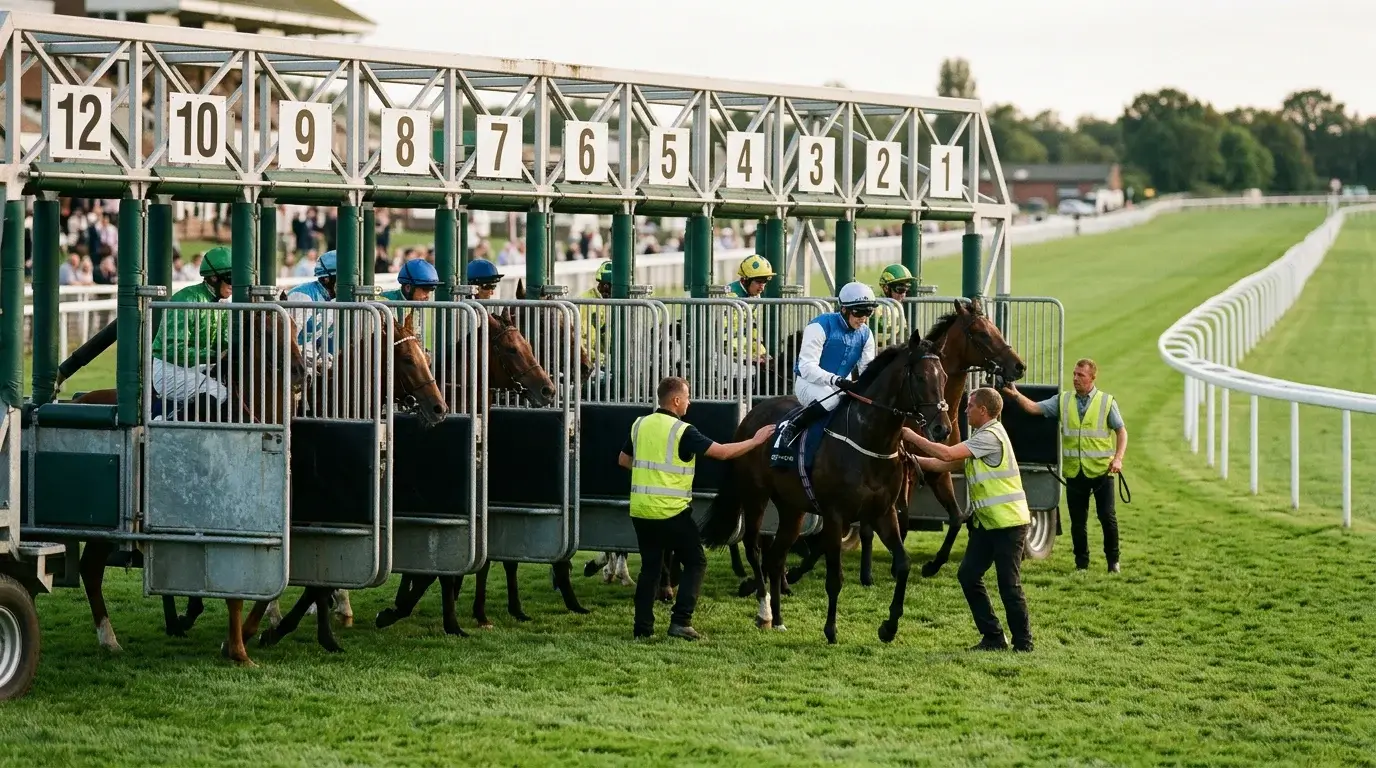
The five-furlong start at Windsor places the field on the straight course, which bypasses the figure-of-eight entirely. There are no bends — the race is run on a straight track that feeds into the home straight. Draw matters here not because of rail positions on bends, but because of ground conditions across the width of the straight. Horses drawn in the middle stalls — roughly stalls 3 through 5 in a typical field — are well positioned to break cleanly and establish a forward position. Stall 4 sits in the heart of that zone. It gives the jockey the option to angle towards either rail depending on where the ground is riding best, without being pinched by neighbours on either side. In a five-furlong race, where fractions of a second matter, that positional flexibility is worth real ground.
Stalls drawn very low — 1 and 2 — might seem ideal because they sit on the stands side, but the data does not support a blanket advantage. Stall 1 can be a trap at five furlongs because the horse is locked into a narrow strip of ground and has nowhere to go if it breaks slowly or if the stands-side ground is riding worse on the day. On softer days, the strip closest to the stands rail can become the most worn section. Stalls drawn high — 8 and above in larger fields — race towards the far rail and on certain going conditions, particularly soft, they can access fresher ground that gives a genuine advantage over the five-furlong trip.
The +94.38 figure for stall 4 should also be understood as a product of sample size. Over five years, there are enough five-furlong races at Windsor to make the number meaningful, but it is not so large that it is immune to a handful of well-backed winners inflating the LSP. Two or three short-priced winners from stall 4 can move the profit line considerably. The smart approach is not to treat stall 4 as an automatic bet but to treat it as a genuine positive factor — something that adds value to a horse that already has the form and the pace profile to be competitive. If a horse drawn in stall 4 also shows early speed and has a jockey who rides Windsor regularly, the combination is worth more than any single piece of that puzzle on its own.
It is also worth noting the stalls that consistently underperform at five furlongs. Very low draws — stall 1 and 2 — show negative LSP figures over the same period when the ground is soft, as these positions are locked into the section of the straight course that absorbs the most wear. If you are considering backing a horse drawn in a position that the going conditions disfavour in a five-furlong sprint at Windsor, you need a strong reason beyond form to believe it can overcome the structural disadvantage.
6 Furlongs: A Slight High-Draw Edge, But Don’t Overbet It
Move up to six furlongs and the draw picture shifts. Six-furlong races at Windsor also use the straight course — starting from a chute that joins the round circuit at the five-furlong marker — so, like the five-furlong trip, there is no bend work involved. The draw dynamics change because the extra furlong means the field is running on the straight for longer, and any difference in ground conditions across the width of the track has more time to influence the result. According to data from DrawBias.com, there is a slight advantage to higher-drawn stalls at six furlongs — but the word “slight” deserves emphasis. This is not a bias you can lean on heavily. It is a marginal tilt, visible in aggregate data, that could disappear entirely in any given race depending on the pace scenario and the going.
The mechanism behind the high-draw edge at six furlongs is primarily about ground conditions. On the straight course, the strip of turf nearest the stands rail tends to take more punishment over the course of a meeting. Horses drawn high — towards the far rail — can race on fresher ground, avoiding the worst of the divots and kickback. On days when the going is testing, this advantage becomes more marked as the ground differential widens across the width of the track.
But the advantage is modest enough that it should never override form. A high draw at six furlongs might be worth a pound or two on the tissue price — something that turns a 7/1 shot into a 6/1 proposition in your assessment — but it is not worth backing a horse with no realistic chance on form just because it is drawn in stall 10. The pace factor remains dominant: a horse drawn low that has the speed to sit second or third through the far-loop bends will outperform a horse drawn high that gets no cover and races wide through the crossover.
Field size matters at six furlongs. In fields of eight or fewer, the draw bias is negligible — there is enough room for every horse to find a position across the width of the straight course. The bias begins to show in fields of ten or more, where the field can split into groups racing on different strips of ground. In the larger fields, the high-draw edge becomes more visible in the data. In the smaller fields that typify many Windsor evening cards, it barely registers.
1 Mile and Beyond: Draw Weakens, Jockeyship Strengthens
At a mile, the draw-bias signal at Windsor fades to a whisper. The data from DrawBias.com shows what is best described as a weak high-draw advantage at one mile — present in the numbers if you look for it, but not statistically robust enough to base a bet on. At a mile and two furlongs, the advantage is weaker still. By the time you reach 1m4f, it has essentially disappeared.
The reason is time and space. A five-furlong sprint lasts roughly a minute. A mile race takes close to one minute and forty seconds, and a mile-and-a-quarter contest stretches beyond two minutes. The longer the race, the more opportunity there is for a jockey to reposition, for the field to spread and for the initial stall position to become irrelevant. At a mile, a horse drawn in stall 1 has enough ground to work across the track and find a position through the bends. A horse drawn in stall 12 has enough time to settle in behind the leaders without losing contact. The figure-of-eight layout still produces its camber changes and its crossover compression, but over the longer trip these become obstacles that a competent jockey can manage rather than decisive factors that determine the result.
What replaces the draw as the key variable at these distances is jockeyship — specifically, the ability to judge pace and position through the crossover. At a mile and beyond, the crossover arrives midway through the race rather than near the end. A jockey who navigates it smoothly, keeping the horse balanced through the camber change, preserves energy for the home straight. A jockey who fights the horse through the crossover, or who moves too early and burns fuel on the far loop, arrives in the home straight with less in the tank. This is one reason why certain jockeys show significantly better records at Windsor than others, even after adjusting for the quality of their mounts.
For the bettor, the practical takeaway at a mile and beyond is straightforward: deprioritise the draw. Spend the time you would otherwise spend on stall analysis looking instead at the jockey booking, the likely pace scenario and the horse’s record on the prevailing going. If two horses appear evenly matched on form and one has a notably better draw, that draw can serve as a tiebreaker — but it should not be the reason you back one horse over another at these distances. The figure-of-eight still shapes the race, but over a mile or more it shapes it through pace and balance rather than through the starting gate.
How Going Changes the Draw: Soft vs Good
Going is the variable that can turn Windsor’s draw bias from a background hum into a shout. On good or good-to-firm ground — the conditions that prevail for most of the summer flat season — the draw biases described above apply in their standard form. The middle-stall advantage at five furlongs is present, the slight high-draw edge at six furlongs is detectable, and the minimal bias at a mile and beyond is barely worth considering. The ground is consistent, the rail is intact and pace is the dominant factor.
On soft ground, the picture changes materially. Data from HorseRacingBettingSites.co.uk indicates that softer going amplifies the high-draw advantage at five and six furlongs. The mechanism relates to how the straight course degrades: Windsor sits beside the Thames on low-lying ground, and when rain arrives, the drainage is slow. On the straight course, the strip of ground nearest the stands rail tends to ride heavier than the far-side strip. Horses drawn low, racing on the stands side, are effectively running through deeper ground than their higher-drawn rivals who can access the far rail. On the round course used for mile races and beyond, the inside rail on the bends takes the most traffic and absorbs the most moisture, shifting the advantage towards wider-drawn horses who can race on fresher ground.
The effect is most dramatic at five furlongs, where the race is over quickly and there is no time to adjust position across the width of the track. A horse drawn low on soft going over five furlongs at Windsor is fighting the ground from the moment the stalls open to the moment it reaches the line. A horse drawn high, on the same going, runs on turf that may be a full going-stick reading better. Over a furlong, that difference might cost a length. Over five furlongs, it can cost a race.
At six furlongs on soft going, the pattern is similar but less extreme. The additional furlong gives the low-drawn horse slightly more time to work away from the worst ground, and the field has more opportunity to spread across the track. The high-draw advantage still strengthens on soft, but it does not dominate to the same degree as at the shorter trip.
On good-to-firm or firm ground, the effect reverses in a subtle way. When the surface is fast and even, the inside rail is not degraded, and the shortest route — the inside line — becomes the best route. In these conditions, low draws can actually outperform, because the horse drawn in stall 1 or 2 saves genuine ground on the bends and faces no penalty for running on the rail. This is one reason why Windsor draw-bias data, when viewed without going breakdowns, can look confusing. The aggregate figures blend together soft-going meetings (where high draws prosper) and fast-going meetings (where low draws hold up), producing an average that understates the real bias in either direction.
The broader context matters here too. “There was much to be pleased about in 2025. Our major meetings and races performed strongly,” noted Richard Wayman, Director of Racing at the British Horseracing Authority, in the 2025 Racing Report. “Of course, there are challenges with the horse population continuing to decline and the betting environment remaining a challenging one.” At Windsor, one of those challenges is the variability of conditions from meeting to meeting — and the going reaches directly into the draw. Checking the forecast and the morning going report before a Windsor card is not a casual habit. It is a core part of the analysis, because the same stall that shows a profit on good ground may show a loss on soft, and the same horse that handles a low draw in July may be disadvantaged by it in a rain-soaked September fixture.
How to Read Draw-Bias Tables Without Overfitting
Draw-bias tables are seductive. A column showing +94 LSP next to stall 4 looks like a licence to print money, and a row of negative numbers against stalls 9 through 12 looks like a clear warning. But tables lie — or, more precisely, they tell the truth about the past in a way that may not carry forward. Reading draw data well means understanding what the numbers can and cannot tell you.
The first question to ask of any draw-bias table is sample size. How many races does the figure represent? At Windsor, the five-furlong programme runs perhaps fifteen to twenty times per season, and not all of those produce fields large enough for draw to be meaningful. Over five years, you might have eighty to a hundred data points per stall at the most popular distances, and considerably fewer at less common trips. That is enough to identify strong patterns — a stall that shows a profit of +94 over a hundred races is telling you something real — but it is not enough to draw fine distinctions between adjacent stalls. The difference between stall 4 at +94 and stall 5 at +60, for example, may be the product of three or four races where well-fancied horses happened to be drawn in stall 4. You should not conclude that stall 4 is definitively better than stall 5; you should conclude that the middle stalls, as a group, outperform the extremes.
The second question is whether the table accounts for going. As discussed above, the draw bias at Windsor shifts with the ground. A table that blends all going conditions will understate the bias on soft ground and overstate it on firm. If the data source does not offer a going breakdown, you are working with blurred information. The best available sources — DrawBias.com and the OLBG dataset — do allow some filtering, but even these have limitations in terms of granularity.
The third trap is treating LSP as the only metric. Level stakes profit tells you what you would have made if you had backed every horse in a given stall for the same stake. It does not tell you about win rate, place rate or the type of race in which the profits were generated. A stall might show a high LSP because it produced one 33/1 winner in five years, which inflates the profit line without reflecting a consistent pattern. Looking at strike rate alongside LSP gives a more stable picture. A stall with a 15% strike rate and a positive LSP is more trustworthy than one with a 5% strike rate and a larger LSP driven by a single outlier.
Finally, resist the urge to build complex models from draw data alone. Draw is one input. Pace is another. Going is another. Class, fitness, trainer form, jockey booking — all of these matter. The bettor who uses draw data as a filter rather than a signal tends to do better over the long run. Use the draw to narrow the field: eliminate horses with a clear structural disadvantage, and give extra credit to those with a structural edge. Then make your final selection based on the full picture. The draw should shape your shortlist, not dictate your bet.
Practical Rules: When to Act on the Draw, When to Ignore It
The data covered in this article points to a set of practical rules that hold up under scrutiny. They are not guaranteed to produce winners — nothing in racing is — but they provide a framework that is more reliable than gut feeling or headline draw numbers stripped of context.
At five furlongs, the draw matters. On the straight course, ground conditions across the width of the track create genuine, measurable advantages for certain stall positions. Middle stalls — roughly stalls 3 through 5 — carry an edge on good going. On soft going, the advantage shifts towards higher stalls towards the far rail, where the ground rides better. If a horse you like is drawn on the wrong side of the track given the day’s conditions, you need a strong offsetting reason — exceptional speed, a weak field, a jockey who knows the track — to justify the bet. Without it, pass.
At six furlongs, the draw carries a mild tilt towards higher stalls, but only in fields of ten or more. In smaller fields, ignore it. On soft going, give it more weight. On good going, give it less. Pace profile and form are still the primary selection criteria at this distance.
At a mile and beyond, the draw is a tiebreaker, not a deciding factor. Invest your analysis time in pace assessment, jockey booking and going preference instead. If two horses are inseparable on form and one has a marginally better draw, that can push the decision — but the draw alone should never be the reason to back a horse at these longer trips.
Across all distances, pace bias outranks draw bias at Windsor. A horse likely to race prominently is always a better proposition than a horse drawn well but likely to be held up. On the round course, the figure-of-eight layout and the tight bends make front-running and prominent-racing styles disproportionately successful, even though the home straight is close to five furlongs. On the straight course used for sprints, early speed is equally vital because there are no bends to create positional reshuffles. Factor the draw into your assessment, but always after you have assessed pace. And always — always — check the going before you commit. At Windsor, the draw and the ground are two halves of the same equation, and reading one without the other gives you an incomplete answer.