
 Available in US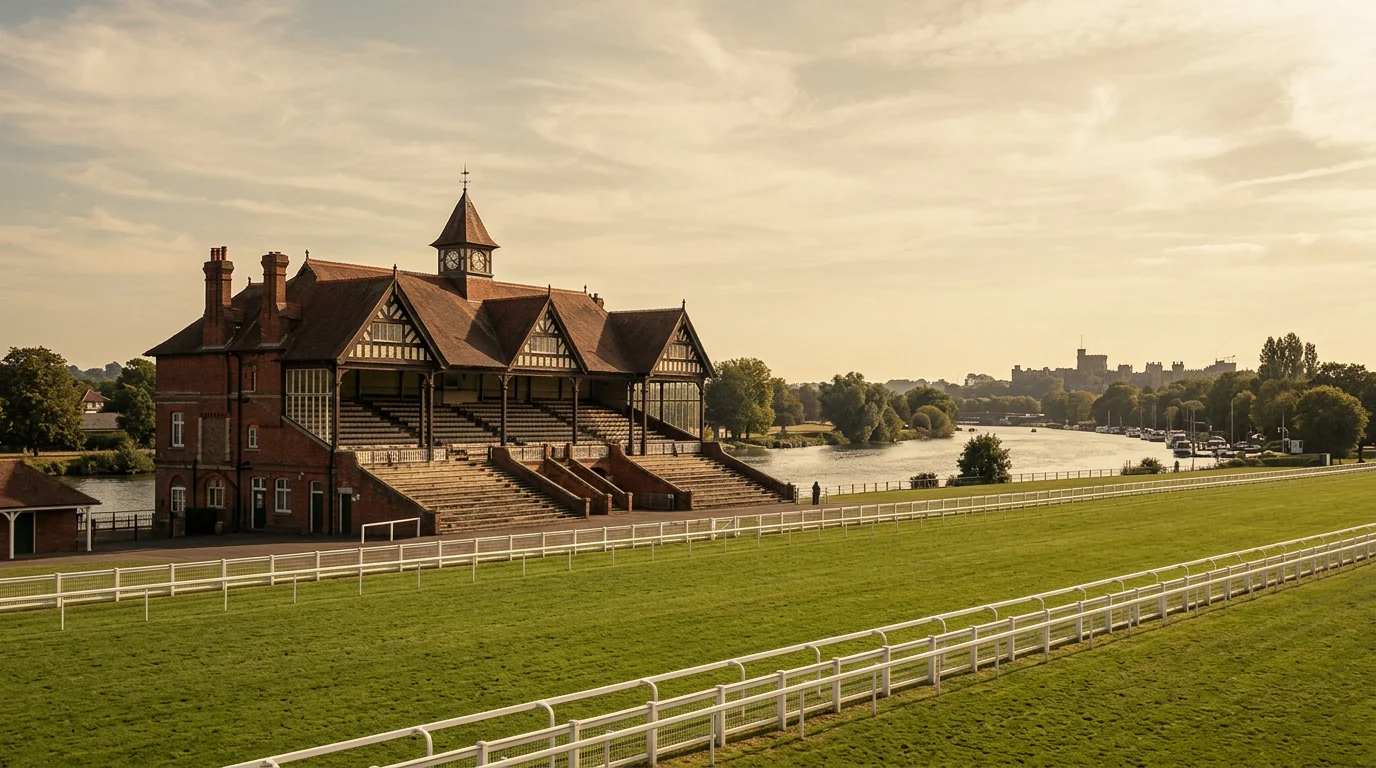
A Racecourse on an Island, Running Since 1866: Windsor’s Unlikely Survival Story
Royal Windsor Racecourse occupies a position in British racing that no other venue can claim. It is the only racecourse in the country situated on an island — a strip of land between the Thames and the Clewer Mill Stream backwater in Berkshire. It is one of only two figure-of-eight courses in Britain. And it is the only racecourse in the UK accessible by river boat from a major town centre. These distinctions are not marketing novelties. They are the direct consequences of geography and history, and they explain why Windsor has survived 160 years of competition, closure threats, and reinvention while other courses of similar size have disappeared. Windsor Racecourse History — More on this topic at windsor betting.
Understanding that history is not essential for placing a bet — but it adds a layer of context that makes the venue’s quirks legible. The figure-of-eight layout exists because the island was too narrow for a conventional oval. The evening racing programme evolved because the proximity to London made after-work attendance viable. The return of jump racing in 2024 was not a novelty — it was a restoration of something that had been part of the course’s identity for decades before it was abandoned. Windsor’s past explains its present, and its present shapes the races you bet on.
Victorian Origins: How Windsor Got Its Figure-of-Eight
Racing at Windsor began in 1866 on the site it still occupies today. The Victorians were prolific racecourse builders, and Windsor’s proximity to the royal residence at Windsor Castle gave it an early connection to establishment patronage. The course was laid out on land that was — and remains — an island in the Thames, bounded by the river on one side and the Clewer Mill Stream on the other.
The island’s shape dictated the track’s design. A standard oval requires a certain minimum width to accommodate two parallel straights and two sweeping bends. The Windsor island was too narrow for that. The solution was the figure-of-eight: a layout that uses the same land twice, with the track crossing over itself to create two loops within the available space. This was not a gimmick or an aesthetic choice — it was the only practical way to fit a racecourse onto the island’s footprint. The resulting track is roughly one mile and four furlongs in total circumference, with the crossing point sitting near the centre.
The Victorian course ran both flat and jump racing from the outset. The flat programme centred on the summer months; the National Hunt fixtures filled the winter calendar. The dual-purpose nature of the track was standard for the era — most British racecourses hosted both codes until the gradual specialisation of the twentieth century split them apart. Windsor was unusual in retaining both codes as long as it did, and the recent return of jump racing in 2024 is in some ways a reversion to the course’s original purpose.
Wars, Closures and Reinvention Through the 20th Century
Unlike most British racecourses, Windsor continued racing during both World Wars — it was one of only three southern courses, alongside Newmarket and Salisbury, permitted to stage meetings during wartime. The proximity to London made it a valuable morale-boosting venue, and the course emerged from each conflict with its racing tradition unbroken. The mid-twentieth century was a period of consolidation for British racing: smaller courses closed, bigger ones modernised, and the industry began its long transformation from a largely aristocratic pursuit into a mass-market entertainment and betting product.
Windsor survived where others did not, partly because of its location. Sitting within easy reach of London by road and rail — and uniquely, by river — it attracted evening crowds that suburban courses further from the capital could not match. The development of floodlit or summer-evening racing in the latter half of the century played directly to Windsor’s strengths. Monday evening meetings became the course’s signature, and the identity of Windsor as an after-work venue — casual, accessible, and atmospheric — solidified during this period.
Jump racing at Windsor was discontinued in December 1998, a decision driven by economics rather than suitability. The cost of maintaining facilities for both codes on a compact site outweighed the revenue that winter fixtures generated, and the course pivoted to flat-only. Windsor briefly hosted some of Ascot’s jump fixtures during Ascot’s 2004–05 redevelopment, but otherwise operated exclusively as a flat track for over two decades, running its Monday evening programme through the summer and leaving the winter calendar empty. The decision was understandable at the time, but it left a gap in the course’s identity — one that would not be properly filled until 2024.
Throughout this period, the course itself remained largely unchanged. The figure-of-eight layout — impossible to modify without demolishing and rebuilding the entire track — preserved the racing characteristics that had defined Windsor since the Victorian era. While other courses invested in extending their straights, widening their bends, or reconfiguring their layouts to suit modern training methods, Windsor’s geography permitted no such renovation. The track you bet on today runs substantially the same lines as the track that hosted its first race in 1866, and that continuity is part of what makes historical form data at the course more relevant than at venues that have been significantly altered.
The ARC Era and the Return of Jump Racing
Windsor is now part of the Arena Racing Company (ARC) portfolio, which operates 16 racecourses across Britain. ARC’s ownership has brought investment in facilities and a commercial approach to programming that balances traditional racing with events designed to attract non-racing audiences. Windsor’s evening meetings, with their mix of competitive racing and social atmosphere, fit the ARC model neatly.
The most significant development of the modern era was the return of jump racing in December 2024, the first time Windsor staged its own National Hunt programme since 1998. The inaugural Berkshire Winter Million in January 2025 — a three-day festival co-promoted with Ascot — attracted 13,170 spectators and carried a prize fund of £1.2 million, since increased to £1.25 million for 2026. The flagship race, the Fitzdares Fleur De Lys Chase, was won by Protektorat in commanding fashion. The event demonstrated that Windsor could sustain quality jump racing alongside its established flat programme, and the 2026 calendar includes four National Hunt fixtures — a meaningful expansion of the course’s winter activity.
For bettors, the ARC era has brought two practical changes. First, the fixture list has stabilised and grown: 26 meetings in 2026 is a healthy programme for a course of Windsor’s size, and the consistency of the calendar makes it possible to plan a season-long approach rather than dipping in sporadically. Second, the return of jumps racing adds a winter dimension that did not exist before — ante-post markets on the Berkshire Winter Million, a new set of form lines to track, and an opportunity to extend your Windsor analysis beyond the flat season. See also Pace Bias at Windsor.
Why History Gives Windsor an Edge No New Course Can Copy
A modern course designer would never build a figure-of-eight. It is an awkward shape, it creates a crossing point that complicates the racing surface, and it produces draw biases that would not exist on a conventional layout. But Windsor’s figure-of-eight was not designed — it was imposed by the island’s geography in 1866, and 160 years of racing have turned that constraint into a distinctive character. The tight turns, the camber, the crossing, the short home straight — all of them produce racing patterns that do not replicate anywhere else in Britain. For the bettor willing to learn those patterns, Windsor’s history is not a footnote. It is the reason the course offers edges that newer, more rationally designed tracks do not.
