
 Available in US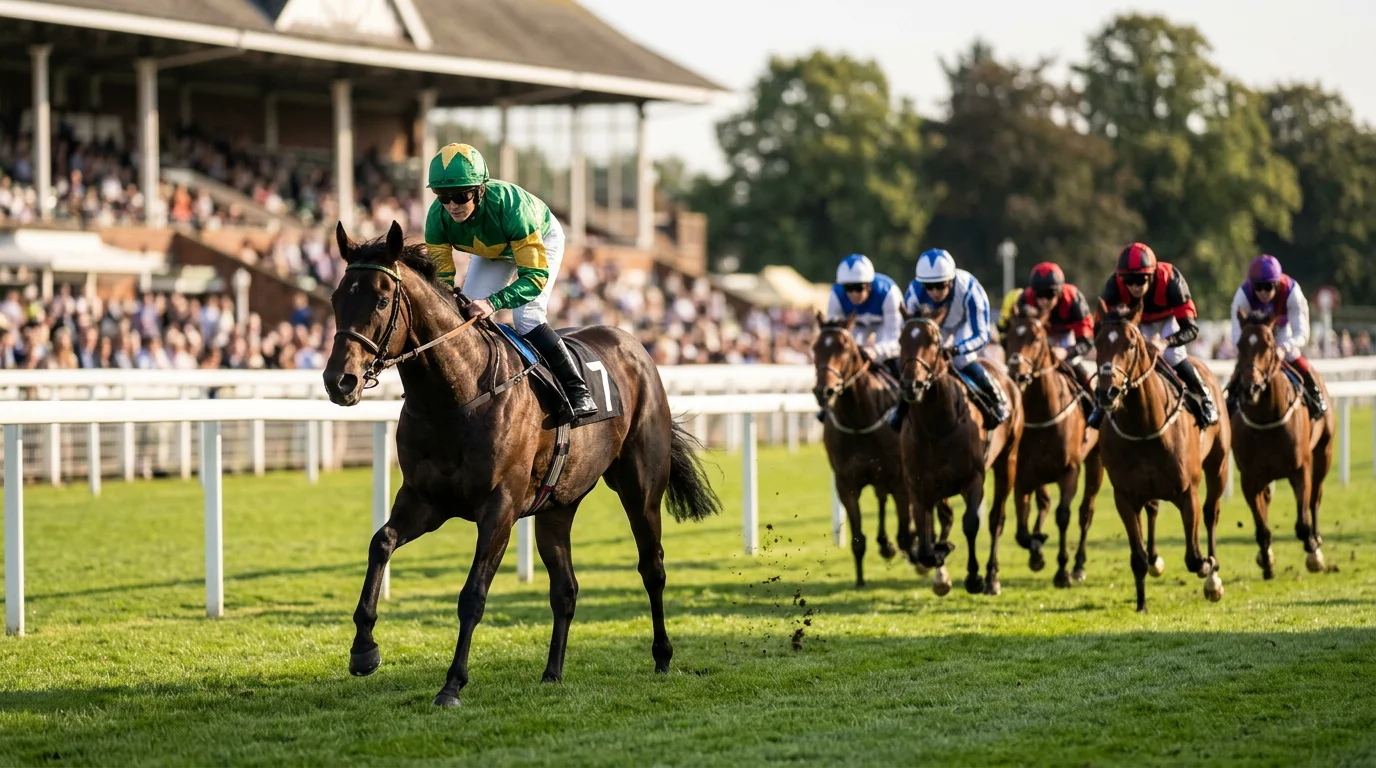
At Windsor, Front-Runners Win Roughly Four Times More Often — and Nobody Talks About It
Ask a punter about bias at Windsor and they will mention the draw. High stalls, low stalls, middle stalls — the draw discussion dominates every preview. What rarely gets the same attention is a more fundamental bias that operates at every distance, on every type of going, and in every class of race: the pace bias. Pace Bias at Windsor — More on this topic at windsor betting.
According to analysis of Windsor results, horses that race on or near the pace win approximately four times as often as those ridden with hold-up tactics. That ratio is not marginal. It is one of the strongest pace biases at any flat course in Britain, and it holds from five furlongs through to a mile and two furlongs. The draw matters at Windsor — but pace matters more, and understanding why gives you a filter that should come before stall position in your selection process.
Pace Bias vs Draw Bias: Two Different Questions
Draw bias and pace bias are related but distinct. Draw bias asks: does starting position affect the outcome? Pace bias asks: does racing style affect the outcome? At most courses, the answer to both is “somewhat.” At Windsor, the answer to the second question is “emphatically.”
The distinction matters for practical purposes. Draw bias tells you which stalls to favour or avoid. Pace bias tells you which type of horse to back or oppose. A horse drawn in the ideal stall but ridden with hold-up tactics is fighting the course’s geometry — the tight turns, the short straight, and the camber all favour horses that establish position early. A horse drawn unfavourably but with natural front-running speed can overcome the draw disadvantage by securing the rail and dictating the race from the front.
This is not to say draw bias is irrelevant. At five furlongs, where the run to the first bend is short, the draw determines which horses can get to the front most easily — and the pace bias then amplifies that advantage. At six furlongs and a mile, the draw effect is weaker, but the pace bias persists. The separation between the two becomes clearest at longer distances: at a mile and two furlongs, draw bias is negligible, but the front-runner advantage remains substantial. Pace, not position, is the primary structural factor at Windsor.
How Pace Advantage Holds from 5f Through 1m2f
At five furlongs, the pace bias is at its most extreme. The race lasts roughly sixty seconds, and there is no time for a held-up horse to recover lost ground. Front-runners and prominent racers dominate the results, and the hold-up style is close to nonviable. The data confirms what common sense suggests: in a short, sharp race on a tight track, the horse that reaches the front first usually keeps it.
At six furlongs, the additional distance provides slightly more opportunity for closers — but not enough to level the playing field. The pace bias remains strongly in favour of on-the-pace runners, with the draw data at this trip showing only a marginal high-draw advantage that pales in comparison to the style-of-racing effect. A hold-up horse drawn perfectly at six furlongs still has worse prospects than a front-runner drawn indifferently.
At one mile, the pace bias moderates but does not disappear. The longer distance gives jockeys more time to position their horses, and the field tends to settle into a rhythm after the first couple of furlongs. Late closers have a better chance at a mile than at sprint distances, but the statistics still favour those who race prominently. Windsor’s home straight is not long enough to allow a horse that has sat five lengths off the pace to swoop past in the final furlong with any reliability. The front-runner or the horse sitting second can kick at the two-furlong marker and often sustain it to the line.
At 1m2f and beyond, the pace bias is less pronounced but still measurable. At these distances, tactical ability and jockeyship play a larger role, and the held-up horse is a more viable proposition. But the underlying structural advantage of racing prominently on a tight, turning track does not vanish — it merely softens. If you must choose between two evenly matched horses at 1m2f, one a front-runner and one a closer, the front-runner gets the nod at Windsor.
How to Spot a Front-Runner in the Form Book
Most form services classify a horse’s running style based on its recent races. The standard categories are Leader (makes the running), Prominent (races in the front two or three), Midfield (sits in the middle of the pack), and Held Up (races towards the rear). These classifications are derived from in-running positions recorded at various points during the race.
For Windsor purposes, you want horses classified as Leader or Prominent. Some form databases use abbreviations — L, P, M, H — beside the horse’s finishing position; others use colour-coded icons. However the information is presented, the relevant question is simple: was this horse in the front three at the halfway point of its recent races? If the answer is yes in three or more of its last five starts, it has natural pace and is likely to adopt a similar style at Windsor.
One subtlety: a horse can have front-running ability but be ridden with hold-up tactics if the jockey or trainer chooses. This happens when a horse is stepped up in distance, dropped in class, or encounters a strong pace that it cannot match. Check the jockey booking alongside the running-style history. If a jockey known for riding prominently — one who typically forces the pace — is booked on a horse with natural speed at Windsor, the intent is clear. If a hold-up jockey is booked on the same horse, the tactical approach may differ, and the pace advantage may be partially surrendered.
Trainer intent also matters. Some trainers instruct their jockeys to make the running at Windsor regardless of the horse’s default style, because they understand the course’s bias. Others allow their jockeys to ride as they see fit. Over time, you can identify which trainers adopt pace-positive tactics at Windsor and weight their runners accordingly.
The Pace Filter That Should Come Before Draw
Before you check the draw, check the pace. Ask: which horses in this race are likely to be on or near the lead at halfway? Those horses start with a structural advantage that operates at every distance and on every type of going at Windsor. The draw amplifies or moderates that advantage at sprint distances, but it does not replace it. A hold-up horse from the perfect stall is still fighting the course. A front-runner from an imperfect stall still has the bias in its favour. See also Windsor Sprint Betting.
The practical sequence for any Windsor selection should run in this order: pace first, then draw, then form, then ground preference. If a horse ticks all four — front-running style, favourable stall, solid recent form, and a proven record on the declared going — you have a strong candidate. If it ticks three out of four but has natural pace, it remains interesting. If it ticks three out of four but is a hold-up horse, the missing piece is the one the course penalises most. Pace before draw — that is the order of operations at Windsor, and the four-to-one ratio in the data is the reason why.
