
 Available in US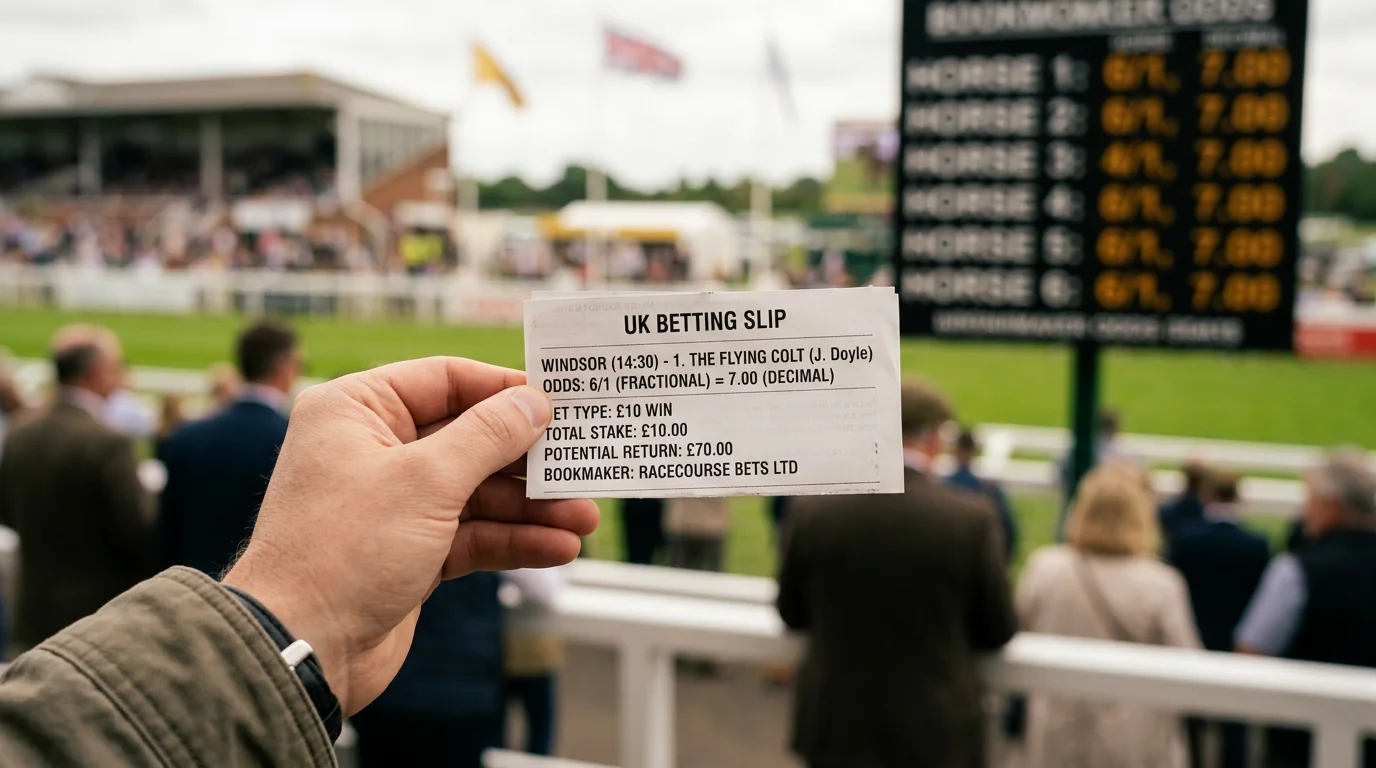
- UK Bookmakers Use Fractions, Exchanges Use Decimals — And the Difference Matters
- Converting Between Fractional, Decimal and American: A Quick Reference
- Implied Probability: What Odds Really Tell You About a Horse's Chances
- The Overround: How Bookmakers Build Their Margin
- Why the Format You Use Can Change Your Decisions
UK Bookmakers Use Fractions, Exchanges Use Decimals — And the Difference Matters
If you have bet at Windsor using a traditional bookmaker — on course or online — you will have seen fractional odds: 5/1, 9/2, 11/8. If you have used a betting exchange like Betfair, you will have seen decimal odds: 6.00, 5.50, 2.38. They describe the same thing — the relationship between your stake and your potential return — but the format you use shapes how you perceive value, compare prices, and calculate payouts. Understanding Fractional and Decimal Odds at Windsor — More on this topic at windsor betting.
This is not a trivial difference. The Gambling Commission’s figures for the year ending March 2025 show that online horse racing generated £766.7 million in gross gaming yield — a figure that includes the bookmaker’s built-in margin on every bet placed. That margin is easier to see in one format than the other, and the punter who can switch between formats fluently is better equipped to spot when a price is generous and when it is not.
This guide covers conversion between the three major formats, explains how to extract implied probability from any set of odds, and shows how the overround — the bookmaker’s margin — works in practice at a Windsor meeting.
Converting Between Fractional, Decimal and American: A Quick Reference
The three formats express the same information differently. Understanding the conversion between them takes a single formula per direction, and once you have it, switching becomes automatic.
Fractional to Decimal: divide the first number by the second, then add 1. So 5/1 becomes (5 ÷ 1) + 1 = 6.00. 11/4 becomes (11 ÷ 4) + 1 = 3.75. 4/6 becomes (4 ÷ 6) + 1 = 1.67. The decimal number always represents your total return per £1 staked, including the stake itself. At 6.00 decimal, a £10 bet returns £60 total. At 3.75, it returns £37.50.
Decimal to Fractional: subtract 1, then express as a fraction. 3.00 becomes 2/1. 4.50 becomes 7/2 (3.50 = 3.5 = 7/2). 1.80 becomes 4/5 (0.80 = 4/5). Some decimals do not convert neatly to standard bookmaker fractions — 2.62, for instance, sits between 13/8 (2.625) and 8/5 (2.60). In practice, bookmakers round to the nearest standard fraction, and exchange users simply work in decimals without converting.
Fractional to American: for odds-against (first number larger), multiply the fractional value by 100. So 5/1 = +500. 3/1 = +300. For odds-on (first number smaller), divide -100 by the fractional value. So 1/2 = -200. 4/6 = -150. American odds are rarely used for UK racing, but they appear on international platforms and in some Asian-market contexts. The positive number tells you the profit on a $100 stake; the negative number tells you how much you need to stake to profit $100.
For everyday use at Windsor, the fractional-to-decimal conversion is the one that matters most. Fractions are what you see on the bookmaker’s board; decimals are what exchanges display and what your calculator understands. The common prices you will encounter at Windsor — evens (2.00), 6/4 (2.50), 5/2 (3.50), 4/1 (5.00), 8/1 (9.00) — are worth memorising in both formats. For anything else, the formula takes five seconds.
Implied Probability: What Odds Really Tell You About a Horse’s Chances
Every set of odds implies a probability — the chance of the outcome that the price represents. Converting odds to implied probability is the single most useful skill in betting, because it lets you compare the market’s opinion with your own assessment and decide whether a price is worth taking.
The formula is simple: implied probability = 1 ÷ decimal odds. At decimal odds of 4.00 (3/1 fractional), the implied probability is 1 ÷ 4.00 = 0.25, or 25%. At 6.00 (5/1), it is 1 ÷ 6.00 = 0.167, or 16.7%. At 2.00 (evens), it is 50%. At 1.50 (1/2), it is 66.7%.
This is where decimals show their advantage over fractions for analytical purposes. Calculating implied probability from 11/4 fractional requires you to first convert to decimal (3.75), then divide. From 3.75 decimal, the calculation is immediate: 1 ÷ 3.75 = 0.267, or 26.7%. The decimal format strips away the layer of arithmetic that fractions add, and when you are comparing five or six runners in the final minutes before a Windsor race, speed of calculation matters.
Now here is the important part: the implied probabilities for all runners in a race will always add up to more than 100%. In a six-runner race at Windsor, you might see implied probabilities summing to 115% or 120%. That excess is the bookmaker’s margin — and understanding it is the difference between a punter who bets and a punter who bets with awareness of what the price actually means.
If a horse’s implied probability is 25% (odds of 4.00) and your own analysis gives it a 33% chance of winning, the price represents value. You believe the horse wins one in three; the market says one in four. Over a long series of such bets, you profit. If the market says 25% and you agree, the bet is neutral at best — and after the bookmaker’s margin, probably slightly negative. Implied probability is the bridge between odds and decisions.
The Overround: How Bookmakers Build Their Margin
The overround is the bookmaker’s built-in edge on every market. In a theoretically fair book, the implied probabilities of all runners would sum to exactly 100%. In a real book, they sum to 110%, 115%, 120% or more — and that excess is the margin the bookmaker expects to earn.
Here is a worked example from a typical Windsor evening handicap with eight runners. Suppose the prices are: 3/1, 7/2, 4/1, 5/1, 6/1, 8/1, 10/1, 14/1. Converting to implied probabilities: 25.0%, 22.2%, 20.0%, 16.7%, 14.3%, 11.1%, 9.1%, 6.7%. The sum is 125.1%. The overround is 25.1% — meaning the bookmaker has priced the race as if there were 1.25 horses competing for every one actually running. That 25.1% is distributed across every price, making each one slightly shorter than the horse’s true chance warrants.
The overround varies between bookmakers and between races. Competitive markets with heavy betting volume — such as a Saturday Group race at Ascot — tend to have tighter overrounds (110-115%). Lower-profile markets — like a Monday evening handicap at Windsor — tend to have wider ones (120-130%), because less money flows through the market and bookmakers price more conservatively. That difference matters: a wider overround means less value per bet, and the punter needs to be more selective to overcome the margin.
The Gambling Commission’s data for the previous financial year showed that online horse racing GGY was £771.1 million — a number that represents the aggregate margin bookmakers extracted from all online horse racing bets. That margin is not an abstract concept. It is the overround on every market you see, compounded across millions of bets. Understanding the overround does not eliminate it, but it lets you identify which prices are closer to fair and which are heavily inflated.
Betting exchanges operate differently. They do not set prices — users offer and accept odds from each other, and the exchange takes a commission (typically 2-5%) on winning bets rather than building a margin into the odds. The result is that exchange prices are generally closer to true probability than bookmaker prices, and the effective overround on an exchange market is often 101-103%. For Windsor races with reasonable liquidity, comparing the exchange price with the bookmaker price tells you exactly how much margin the bookmaker is charging on each runner.
Why the Format You Use Can Change Your Decisions
Fractional odds are tradition. Decimal odds are clarity. The format you use is largely a matter of preference, but if you only ever look at fractions, you are making it harder for yourself to do the one calculation that separates recreational betting from informed betting: converting price to probability and comparing it with your own assessment. See also Windsor Exacta and Trifecta Betting.
Switch your bookmaker account to decimal display for a week. You will notice two things almost immediately. First, comparing prices between runners becomes faster — 4.50 versus 5.00 is more immediately intuitive than 7/2 versus 4/1. Second, the implied probability calculation becomes trivial: divide 1 by the decimal, and you have the market’s opinion of the horse’s chances in front of you. See the margin before you bet — and you will start making better decisions at Windsor without changing anything else about your approach.
