
 Available in US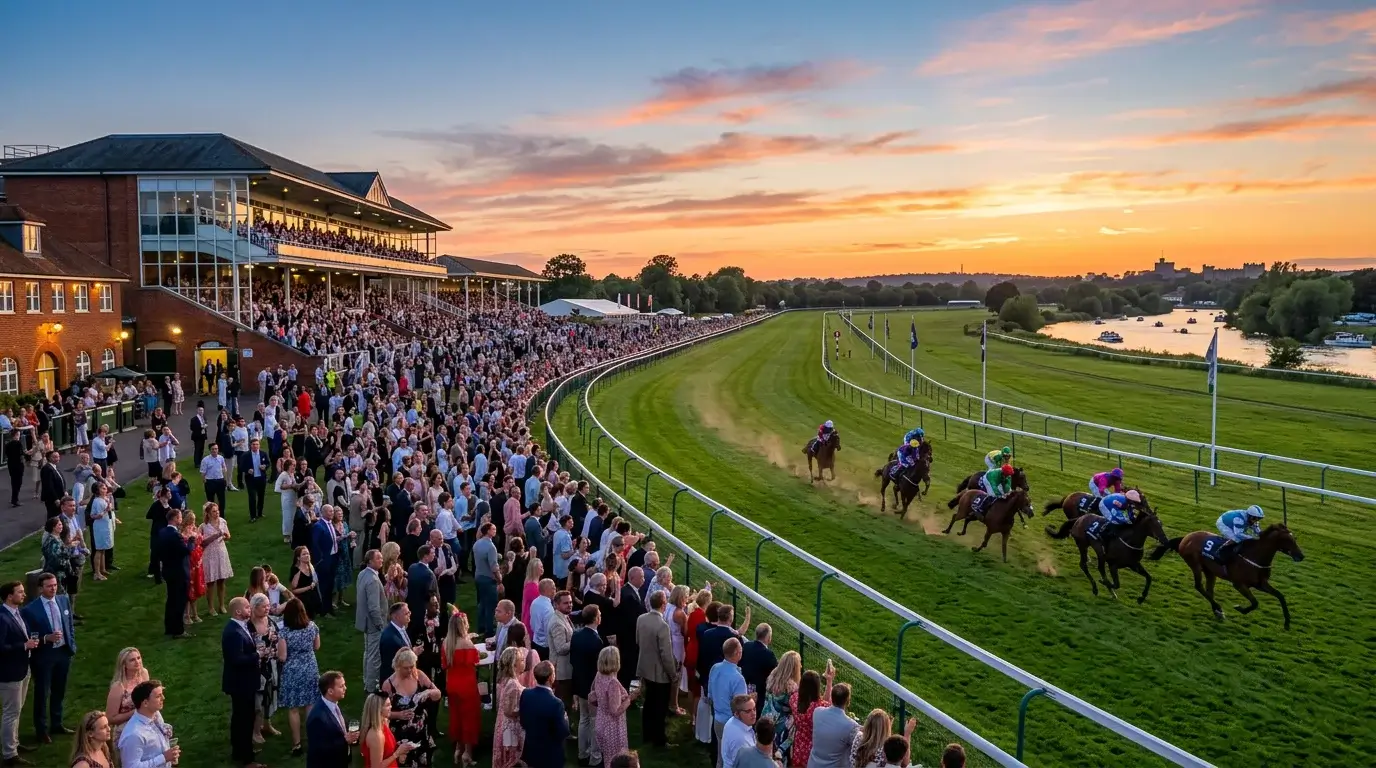
Monday Nights at Windsor: Why Smaller Cards Don’t Mean Smaller Edges
Windsor’s identity as a racing venue is built around Monday evenings. The course runs 22 flat fixtures in 2026, and the majority of those fall on Monday nights between April and October — six or seven races starting from late afternoon and finishing around half eight. It is after-work racing in the truest sense: smaller cards, shorter queues, and an atmosphere closer to a local meet than a festival. Windsor Monday Night Racing — More on this topic at windsor betting.
For punters, that format creates both constraints and opportunities. The constraints are obvious: fewer races mean fewer chances to recover from a bad start, and the fields are often smaller than at weekend meetings. The opportunities are subtler but more valuable. Evening racing at a Core-tier venue attracts a different calibre of entry than a Saturday Premier fixture. The trainers who target these meetings tend to do so deliberately, the market is thinner and therefore more prone to mispricings, and the punter who has done even moderate homework walks in with a structural advantage over the casual crowd.
Smaller Fields, Different Maths: How Evening Racing Changes the Game
The BHA’s 2025 Racing Report puts the average field size at Core flat fixtures at 8.65 runners. Windsor’s Monday evening cards often sit at or slightly below that mark — seven or eight runners is a common sight, particularly in conditions races and novice stakes. The handicaps tend to attract nine to eleven, occasionally more.
Smaller fields change the betting landscape in several ways. First, the each-way market tightens. In a seven-runner race, bookmakers typically pay only two places instead of three. That makes each-way a less attractive proposition for marginal selections and pushes value towards win-only betting in the shorter-field races. Second, the favourite’s strike rate tends to rise. In fields of six or seven, the market leader wins more often than in fields of twelve — not because it is a better horse, but because there are fewer things that can go wrong. Betting favourites in small fields is not inherently profitable (the prices are too short for that), but opposing them requires stronger conviction than in a big-field handicap where chaos is more likely.
Third, and most usefully for the prepared punter, smaller fields make the entire card more analysable. At a Saturday Premier meeting with fourteen-runner handicaps, thorough form study on every runner across every race is a full day’s work. On a Monday evening at Windsor, six races with an average of eight runners each means 48 horses to assess. Spend twenty minutes per race before you arrive and you will know the card better than the vast majority of people betting on it. That informational advantage is the real edge of evening racing — not any specific angle, but the feasibility of doing the work.
The flip side is that smaller fields mean less liquidity in the betting market. Prices can be volatile in the final minutes before the off, and a single large bet from a stable connection can shift the odds noticeably. If you have identified a selection and the price is fair, take it early rather than waiting for the SP. At Windsor’s evening meetings, the best prices do not always survive until the stalls open.
Which Trainers Target Monday Evenings?
Not every trainer treats a Monday evening at Windsor the same way. The big Newmarket operations — Godolphin, the Gosden yard, Charlie Appleby — will send runners when a horse fits the race, but Windsor’s evening cards are not their primary battlefield. The trainers who consistently target these fixtures tend to be the Lambourn, Epsom and south-coast yards for whom Windsor is a convenient local venue: a 45-minute box ride with minimal fuss.
That geographical convenience matters, because it shapes the intent behind entries. A local trainer sending a horse to Windsor on a Monday evening has usually chosen this specific fixture for a reason. The horse might suit the track, the ground, or the class of race. It might need an evening run after a break, where a low-key meeting provides a gentle reintroduction. Or the trainer might be targeting a particular race that falls within a narrow rating band where the horse is well placed. Whatever the reason, entries from local yards at evening fixtures tend to be more purposeful than entries at busier, more competitive meetings.
This creates a subtle information asymmetry. The casual punter sees a modest Monday card and bets on name recognition — the biggest-name trainer, the jockey with the most winners, the horse whose form figures look cleanest at a glance. The sharper punter asks: which trainer here has made a deliberate choice to run at this specific meeting, and what does that choice tell me about the horse’s readiness? A small-yard trainer with a 15% strike rate at Windsor who sends a horse to a race it demonstrably fits is often a better proposition than a big-name operation running a horse on autopilot.
Tracking trainer patterns across Windsor’s season is straightforward. Most form services allow you to filter by course and trainer. After two or three Monday meetings, patterns emerge: certain yards appear repeatedly, their horses tend to run to a consistent standard, and their strike rates at this specific venue diverge from their national figures. Build a shortlist of five or six trainers whose Windsor evening record is solid, and check it before every meeting. It takes five minutes and it narrows the field of serious contenders faster than any other single filter.
Adjusting Your Staking for a 6-Race Card
A six-race card demands a different staking rhythm than a festival day with eight or nine races. The margin for error is thinner — one bad result from six is a larger proportion of your evening than one from nine — and the temptation to chase losses in the final races is stronger because there are fewer of them left.
The simplest approach is flat staking: allocate an equal amount to each race you choose to bet on, and accept that some races might not warrant a bet at all. If your evening budget is £60 and you plan to bet on four of the six races, that is £15 per race. The other two races — perhaps a five-runner conditions stakes with a short-priced favourite, and a maiden with several unraced debutants — are observation rounds. No bet, no loss, no regret.
Selectivity is the single most important adjustment for evening cards. At a bigger meeting, volume gives you room to experiment: a speculative each-way on an outsider, a Placepot entry for entertainment, a win bet on your strongest fancy. On a six-race card, each bet carries more weight. Restricting yourself to the two or three races where your analysis gives you genuine confidence is not conservative — it is optimal. The races where you have no view are the ones that drain a bankroll quietly over the course of a season.
If you are running a Placepot alongside your individual race bets, budget for it separately. A small Placepot perm — eight or twelve lines at 10p — gives you a stake in the entire card without inflating your race-by-race exposure. Treat it as a fixed cost of the evening rather than an additional bet, and do not adjust your individual race stakes to accommodate a bigger perm.
The Monday Night Bettor’s Checklist
Before a Windsor Monday evening, run through four things. First, check the going — declared in the morning, but likely to change through the evening. Second, review the card for field sizes: races with seven or fewer runners favour win-only betting and demand stronger confidence in your selection. Third, check which trainers are running and whether they have a pattern at Windsor evenings. Fourth, set a budget, pick the races where your analysis is strongest, and leave the rest alone. See also Windsor 2-Year-Old Races.
Monday night racing at Windsor rewards the punter who treats it as a specialist pursuit rather than a casual fill between weekends. The cards are compact, the fields are manageable, and the preparation required is modest compared to a full Saturday programme. The evening angles are there for the regular punter who turns up with a plan — and the edge grows with every meeting where you record what worked and why.
