
Each-Way Isn’t Just a Safety Net — at Windsor, It’s a Strategy
Most punters first encounter each-way betting as a hedge — a way to soften the blow when a fancied horse misses the win but finishes in the places. There is nothing wrong with that instinct, but treating each-way as a reluctant compromise misses its real value. At the right price, in the right field, each-way is not a consolation prize. It is the primary bet.
Windsor’s evening meetings are a particularly good testing ground for this idea. The fields are moderate — the BHA’s 2025 Racing Report puts the national average flat field size at 8.90 runners — which means place terms shift depending on the race. A six-runner novice stakes offers only two places; a twelve-runner handicap offers three. That variation creates pockets of value that a blanket each-way approach will miss. The trainer J J Bridger, to pick one example from OLBG’s five-year Windsor data, shows an each-way level stakes profit of +59.71 points — an edge built almost entirely on horses that placed rather than won.
This guide breaks down exactly how each-way works, when Windsor’s conditions favour it, and when you are better off betting win-only.
How Each-Way Works: The Mechanics in 60 Seconds
An each-way bet is two separate bets rolled into one: a win bet and a place bet, both at the same stake. If you bet £5 each-way, you are spending £10 total — £5 on the horse to win and £5 on the horse to place. These are independent bets. If the horse wins, both parts pay out. If it finishes in the places but does not win, only the place part pays.
The place part is calculated as a fraction of the win odds. The standard fraction for most flat races with eight or more runners is a quarter of the odds. So if your horse is 10/1 and finishes second in a qualifying race, the place part pays at 10/4 — which is 5/2, returning £17.50 on a £5 stake (£12.50 profit plus £5 returned). You lose the £5 win bet, so the net outcome on a £10 total outlay is +£7.50.
That arithmetic is worth internalising because it determines the breakeven point. At quarter the odds, each-way starts showing a mathematical edge over win-only when the horse’s chance of placing significantly exceeds its chance of winning — the kind of horse that consistently runs into the frame without quite getting its head in front. Windsor produces plenty of those, particularly in lower-grade handicaps where the form is tightly compressed and two or three lengths can separate the first five home.
The fractions change with field size and race type, which is where Windsor’s specific conditions come in.
Place Terms at Windsor: What Changes with Field Size
Place terms in British racing are not universal — they depend on the number of runners declared. The standard structure, which applies at Windsor and everywhere else, works as follows. In races with five to seven runners, bookmakers pay two places at a quarter of the win odds. With eight or more runners, three places at a quarter the odds. In handicaps of sixteen or more runners, most bookmakers extend to four places, sometimes at a fifth of the odds instead of a quarter. Below five runners, most firms offer win-only or will negotiate individual terms.
At Windsor’s evening meetings, the typical field falls squarely into the eight-to-twelve runner bracket. National average flat field size dropped to 8.90 in 2025, and Windsor’s Core fixtures often sit around that mark or slightly below. This means the default each-way terms you will encounter most often are three places at a quarter the odds. You will occasionally see a five- or six-runner conditions race — usually earlier on the card — where only two places apply. And once or twice a season, a big-field handicap might cross the sixteen-runner threshold and open up four places.
The practical consequence is straightforward: each-way value at Windsor lives in the handicaps, where fields are larger and the place terms are more generous. In a six-runner novice stakes, each-way often represents poor value because the place fraction is applied to shorter odds (favourites in small fields tend to be shorter) and only two places are paid. You are paying double the stake for what amounts to a modest insurance policy. In a ten-runner handicap at the same meeting, three places at a quarter the odds on a 12/1 shot is a different proposition entirely — the place part alone returns 3/1, and your total outlay has a much more favourable risk profile.
One detail worth noting: some bookmakers run enhanced place-term promotions for specific meetings or specific races. These might offer four places at a quarter the odds in a race that would normally pay three. Windsor’s Monday evening fixtures do not always attract these promotions — they are more common for weekend meetings and festivals — but it is worth checking, because an extra paid place shifts the each-way equation materially.
When Each-Way Outperforms Win-Only at Windsor
The simplest rule is this: each-way outperforms win-only when a horse’s implied place probability is higher than the market suggests. That sounds abstract, so here is how it plays out at Windsor in practice.
The first scenario is the consistent placer at a double-digit price. A horse priced at 14/1 in a ten-runner handicap has an implied win probability of around 7%. But if its recent form shows four finishes in the first three from its last six starts, its placing probability is closer to 60-65%. The place part of an each-way bet at 14/1 pays 7/2 — implying the horse needs roughly a 22% chance of placing to break even on that leg alone. At 60%+, you are getting enormous overlay on the place portion. The win part is speculative; the place part is the engine.
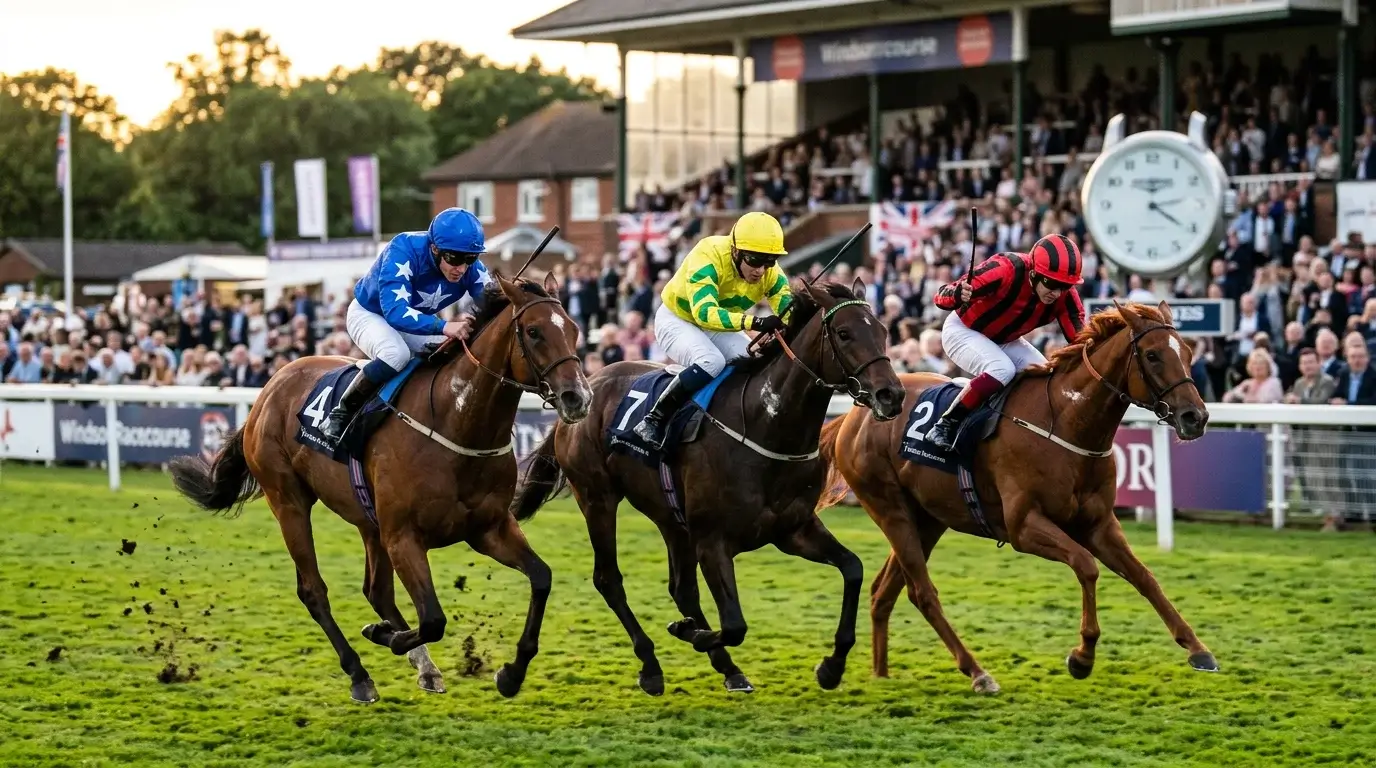
The second scenario involves Windsor’s figure-of-eight layout and how it produces bunched finishes. At courses with long straights and galloping layouts, the cream tends to separate more decisively. Windsor’s tight turns, the crossing point and the camber compress the field, particularly over six furlongs and a mile. Horses that travel well through the race but lack a decisive turn of foot — the type that wins once every eight or nine starts — place far more often than their win record implies. Each-way catches that pattern; win-only misses it entirely.
The third scenario is trainer-specific. Some trainers at Windsor consistently produce placed horses without landing the win. Bridger’s each-way LSP of +59.71 over five years tells that story in one number: his runners place at a rate that generates steady profit even when they do not win. Identifying trainers whose runners overperform in the place market is one of the quieter edges available at Windsor, and it requires nothing more complicated than checking the each-way column in a stats table.
Conversely, each-way is a poor choice in small fields with short-priced favourites. If there are six runners and the favourite is 6/4, backing it each-way means the place part pays at roughly 3/8 — less than half your stake back for a place finish. You are paying double for very little additional protection. In these races, win-only or passing the race altogether is usually the sharper move.
The Quick Each-Way Checklist
Before placing an each-way bet at Windsor, run through four questions. First, how many runners are declared? If fewer than eight, place terms tighten and each-way value drops sharply. Second, what price is the horse? Each-way as a strategy needs odds of at least 5/1 to generate meaningful returns on the place leg — below that, win-only is usually cleaner. Third, does the horse’s form show consistent placing? A horse that finishes in the first three in half its starts is a better each-way candidate than one with a single brilliant win and a string of mid-division efforts. Fourth, are there any enhanced place-term promotions running? An extra paid place changes the maths more than most punters realise.
Each-way betting is not a fallback for punters who cannot decide. Used selectively — in the right field sizes, at the right prices, with the right form profiles — it is one of the most reliable ways to grind out profit across Windsor’s evening cards. The place market is where many of the course’s quietest edges sit, and each-way is the simplest way to access them.