
 Available in US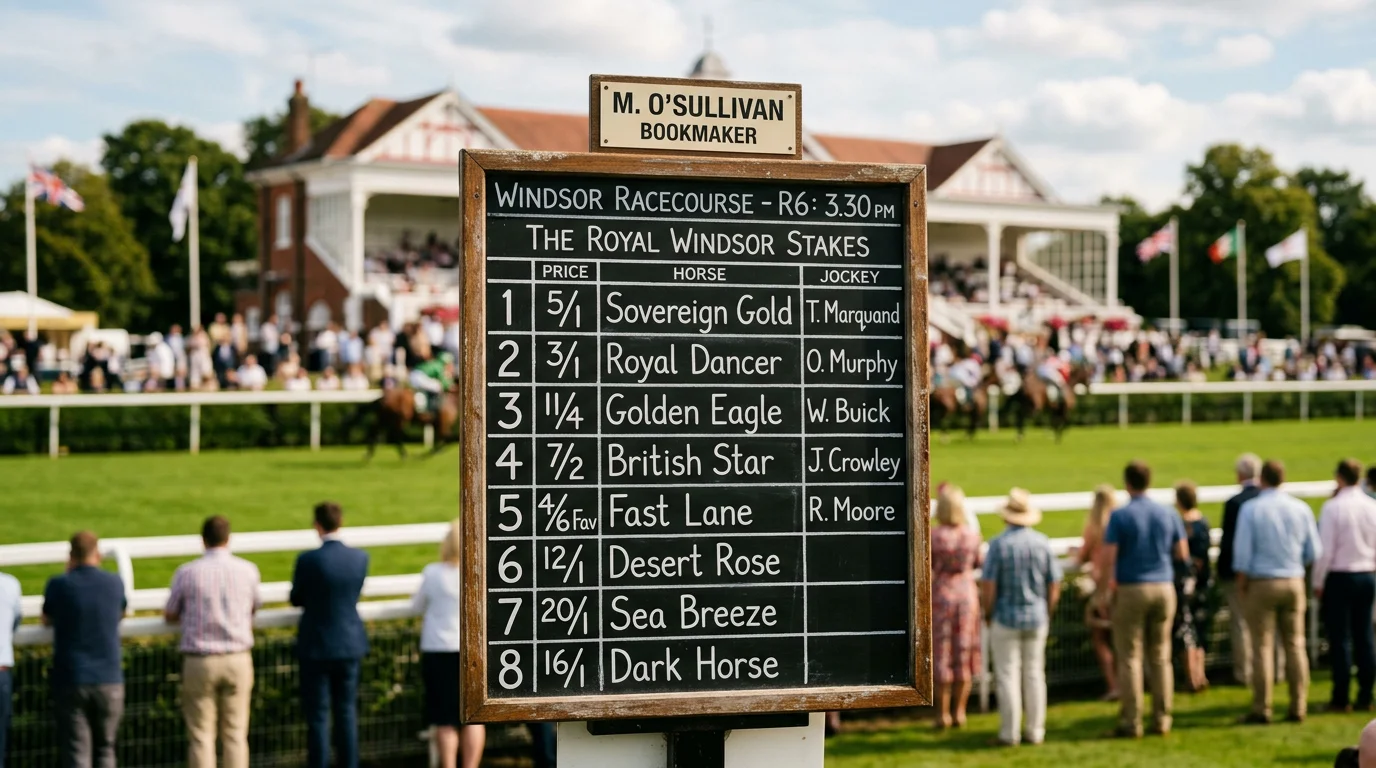
Odds Are the Language of Racing — Here’s How to Speak It at Windsor
Walk up to a bookmaker’s board at Windsor on a Monday evening and you will see a column of numbers next to each horse’s name: 5/1, 11/4, 4/6, 7/2. If those fractions mean nothing to you, you are not alone — and you are not at a disadvantage, because understanding them takes about ten minutes, not a mathematics degree. Windsor Betting Guide for Beginners — More on this topic at windsor betting.
Odds are the market’s way of expressing two things simultaneously: how likely a horse is to win, and how much you stand to gain if it does. A horse at 2/1 is considered more likely to win than one at 10/1, and pays less accordingly. That relationship between probability and payout is the foundation of every bet you will ever place, and once you internalise it, the racecard stops being a wall of numbers and starts being a decision-making tool.
According to a 2025 survey of UK gambling habits, roughly 15% of British adults bet on horse racing at least once a month, with the 25-to-34 age group the most active segment. Many of those punters navigate odds intuitively — they know that 5/1 pays more than 2/1 — without fully understanding the mechanics behind the numbers. This guide is for anyone who wants to move from intuition to comprehension, using Windsor’s evening meetings as the worked example.
Fractional Odds: What 5/1, 11/4 and 4/6 Actually Mean
Fractional odds are the traditional British format, and they are what you will see on the boards at Windsor and on most UK bookmaker websites by default. The fraction expresses the profit relative to the stake. At 5/1 (read as “five to one”), you win £5 for every £1 you stake. At 2/1, you win £2 per £1. At 10/1, you win £10 per £1. The total return includes your original stake as well — so a £10 bet at 5/1 returns £60: £50 profit plus your £10 back.
Where it gets less intuitive is with fractions that are not whole numbers. 11/4 means you win £11 for every £4 staked. That is £2.75 per £1, or £27.50 profit on a £10 bet (total return £37.50). 7/2 means £7 profit for every £2 staked — £3.50 per £1, or £35 profit on a £10 bet (total return £45). The easiest way to handle these is to divide the first number by the second: 11 ÷ 4 = 2.75, so multiply your stake by 2.75 to get the profit.
Then there are odds-on prices — fractions where the first number is smaller than the second. At 4/6, you win only £4 for every £6 you stake, or roughly 67p per £1. A £10 bet at 4/6 returns £16.67 total (£6.67 profit). Odds-on horses are considered more likely to win than to lose, and they are common in small-field conditions races at Windsor where a well-fancied horse faces limited opposition. The returns are modest, but the strike rate is higher.
A few prices appear so often that they are worth memorising outright. Evens (1/1) means you double your money — £10 returns £20. 6/4 means £15 profit on a £10 bet. 9/2 means £45 profit on £10. 100/30, which bookmakers sometimes display as 10/3, is £33.33 on a tenner. Beyond these common odds, the division method works for everything.
One terminology note: when a bookmaker says a horse is “5/1”, the first number is always the profit and the second is always the stake. This is consistent across all fractional odds. The only exception is when someone says a horse is “5 to 1 on” — that means 1/5, an extreme odds-on price where you risk £5 to win £1. At Windsor evening meetings, you will rarely encounter odds shorter than 4/6 or 1/2 in a competitive race.
Calculating Returns: Stake × Odds, Explained with Windsor Examples
The formula for calculating returns from a win bet is: profit = stake × (first number ÷ second number). Total return = profit + stake. That is all you need.
Suppose you back a horse at 7/2 in the third race at Windsor with a £10 stake. Profit = £10 × (7 ÷ 2) = £10 × 3.5 = £35. Total return = £35 + £10 = £45. If the horse loses, you lose the £10 stake.
For an each-way bet, you need to calculate two parts separately. Take a £5 each-way bet (total outlay £10) on a horse at 8/1 in a race with eight or more runners — standard Windsor handicap terms of a quarter the odds for three places. If the horse wins: win part profit = £5 × 8 = £40; place part profit = £5 × (8 ÷ 4) = £5 × 2 = £10. Total return = £40 + £10 + £5 + £5 = £60. If the horse finishes second or third but does not win: win part is lost (−£5); place part profit = £10. Total return = £10 + £5 = £15 on a £10 outlay, so net profit of £5.
These calculations are straightforward with a phone calculator, and most bookmaker apps show the potential return before you confirm the bet. The reason it is worth understanding the maths yourself is that it lets you compare value across different odds and bet types. Is a £10 win bet at 4/1 better than a £5 each-way bet at 8/1? The answer depends on your assessment of the horse’s chance of winning versus placing, and you cannot make that comparison without knowing what each bet pays.
For context, BHA evidence to Parliament showed that the average pool bet at Royal Ascot works out to around £13.57 per bet. At Windsor’s more low-key evening meetings, most recreational punters stake between £5 and £20 per race. Whether you bet £5 or £50, the return calculation works identically — only the scale changes.
Why Odds Change: Market Forces Before the Off
Odds are not fixed. From the moment a market opens — often the morning of the race — prices shift in response to the weight of money backing each horse. A horse that opens at 8/1 in the morning might be 5/1 by the time the stalls open if enough punters have backed it. Conversely, a horse that opens at 3/1 and drifts to 6/1 has been deserted by the market — money that was expected to come for it has gone elsewhere.
These movements contain information. A horse that shortens in price is being backed by someone — possibly stable connections, possibly professional punters, possibly the public following a newspaper tip. A horse that drifts is being avoided. Neither signal is infallible, but in the final ten minutes before a race at Windsor, significant market moves are worth noting. A horse that was 10/1 at lunchtime and is 5/1 at the off has attracted serious money from someone who believes the morning price underestimated its chances.
Two practical points follow from this. First, if you have a strong opinion about a horse and the current price represents value, take the price rather than waiting. At Windsor’s evening meetings, late money can move the market sharply in a thin-liquidity environment — waiting for the off might cost you two or three points of odds. Second, if you are undecided between two or three horses, watching the market in the final minutes before the off can break the tie. The horse attracting late support is the one that someone with insider knowledge — or at least more information than the public — thinks is going to run well.
Most bookmaker apps show live price movements and some display a market-mover indicator. Use this information as a supplementary signal, not a primary one. Market moves confirm or challenge your existing opinion; they should not replace it.
Three Things About Odds That Matter More Than Memorising Fractions
First, odds reflect probability. A horse at 4/1 is considered to have roughly a 20% chance of winning (1 ÷ 5 = 0.20). A horse at 10/1, roughly 9%. These implied probabilities are not predictions — they include the bookmaker’s margin — but they tell you what the market thinks. If your own assessment gives a horse a 30% chance and the market says 20%, you have found a potential value bet. That gap between your opinion and the market’s is where long-term profit lives.
Second, longer odds do not mean worse bets. A horse at 10/1 that wins once every eight starts is a better long-term proposition than a horse at 2/1 that wins once every four starts. The first horse generates profit over time; the second breaks even or loses. Price alone tells you nothing about value — price relative to probability tells you everything. See also Understanding Fractional and Decimal Odds at Windsor.
Third, the best time to learn is at the track. Windsor’s Monday evenings, with their compact cards and moderate fields, are an ideal classroom. Bet small, calculate your returns manually the first few times, watch the market move, and compare the prices you took with the starting price. After three or four meetings, the fractions will be second nature — and more importantly, you will start to see when a price represents an opportunity and when it does not.
