
 Available in US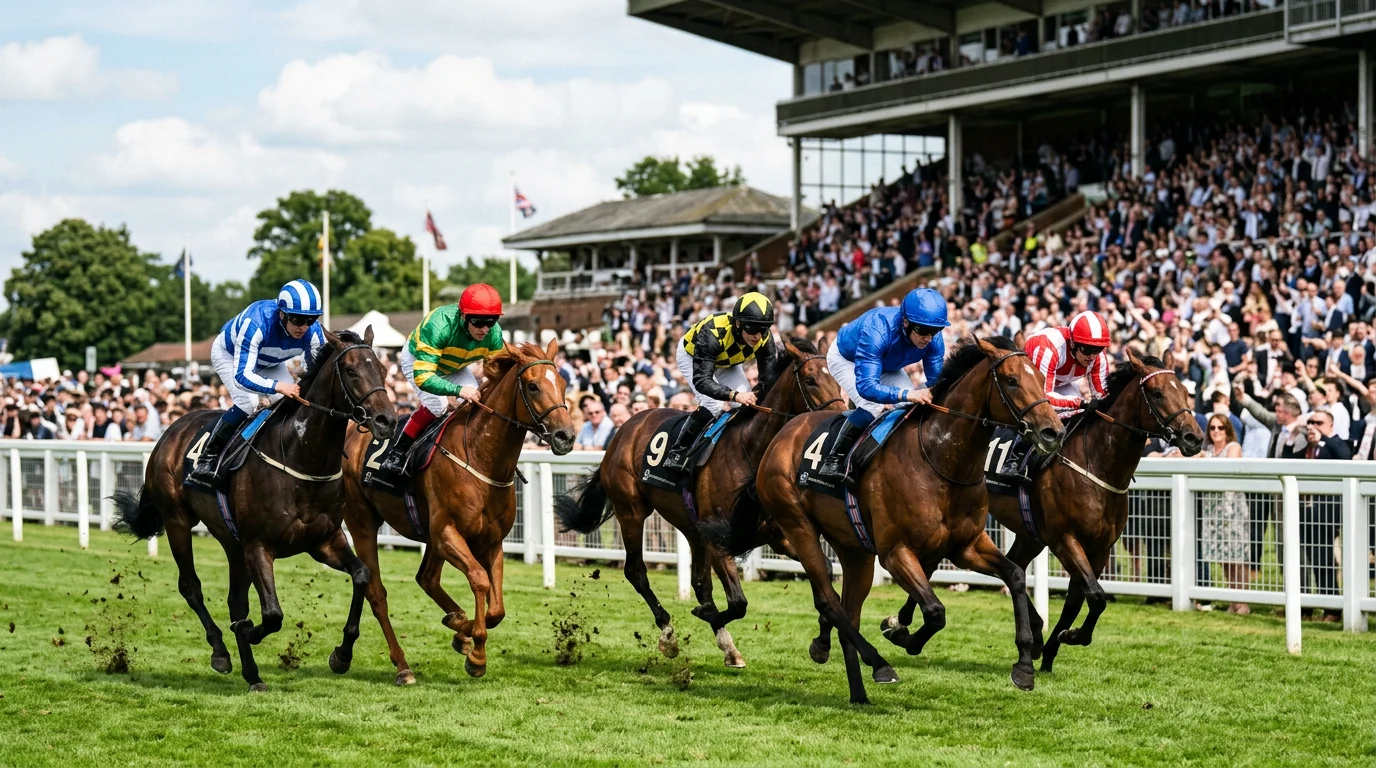
- £1.25 Million in January, Group 3 Quality in August: Windsor's Racing Calendar Punches Above Its Weight
- Winter Hill Stakes: Group 3 Prestige at 1m2f
- Berkshire Winter Million: How Jump Racing Changed Windsor's Year
- Royal Windsor Stakes, Leisure Stakes and the Summer Programme
- High Value Developmental Races: Why They Matter for Punters
- Ante-Post Value: When to Strike Early on Windsor Features
- Feature Races Are Where Windsor's Edge Shows Most
£1.25 Million in January, Group 3 Quality in August: Windsor’s Racing Calendar Punches Above Its Weight
Windsor is not the first course you think of when someone mentions feature races. Ascot, Goodwood, York — those are the venues that own the big-race calendar in the public imagination. Windsor is the Monday night track, the evening card, the course where handicaps outnumber conditions races on most fixtures. And yet the numbers tell a different story. In January, Windsor shares billing with Ascot for the Berkshire Winter Million, a festival that offered £1.25 million in prize money for 2026 and drew 13,170 spectators across three days in its inaugural running. In August, the course hosts the Winter Hill Stakes, a Group 3 contest over a mile and two furlongs that has attracted some of the best middle-distance horses trained in Britain. Between these two anchors, a programme of Listed races, heritage handicaps and developmental fixtures gives Windsor a racing calendar with more substance than its Monday-evening reputation suggests. Windsor Feature Races — More on this topic at windsor betting.
Prize money across British racing reached a record £194.7 million in 2025, according to the BHA Racing Report, with contributions rising from the Levy Board, racecourses and owners alike. Windsor sits within that rising tide. Its feature races are not the richest in the country — that title belongs to the major festival meetings — but they occupy a tier where the prize money is sufficient to attract genuine quality without the field sizes being compressed to five or six runners, as can happen at the top end. For the bettor, this is a sweet spot: races with enough quality to be meaningful and enough runners to generate competitive markets.
This article profiles the key races on Windsor’s calendar, explains why each matters from a betting perspective and identifies the angles — ante-post and on the day — that offer the most consistent value. The focus is on prize money, prestige and punting angles, in that order, because at Windsor the three are closely connected.
Winter Hill Stakes: Group 3 Prestige at 1m2f
The Winter Hill Stakes is the centrepiece of Windsor’s flat programme. Run over a mile and two furlongs, it carries Group 3 status and a prize fund of £70,000 — a figure that has risen by £10,000 since 2023, according to Windsor Racecourse’s official records. The race typically takes place on a Saturday afternoon in August, giving it a different feel from the evening cards that define most of the Windsor calendar. Fields are generally small — six to nine runners — which reflects the quality required to compete at Group 3 level and the limited pool of suitable horses in training at that point in the season.
The history of the Winter Hill Stakes is dominated by two names. Sir Michael Stoute holds the trainer record with ten victories, a figure that spans decades and reflects the late trainer’s sustained ability to produce horses that peaked at exactly the right time for this race. Frankie Dettori, with five wins, is the most successful jockey in the race’s history. Both records were built on a common principle: the Winter Hill rewards class over course form. Because the field is small and the prize money significant by Windsor standards, the typical winner is a horse stepping down from Group 2 or even Group 1 company — a runner whose form at the highest level gives it a decisive edge over exposed Windsor regulars.
Saeed bin Suroor extends the Godolphin connection further. His eight wins in the Winter Hill make him the most prolific active trainer in the race, and his approach is consistent: target a horse with solid middle-distance form, often one that has run in the Eclipse, the Juddmonte International or the King George, and use the Winter Hill as either a stepping stone or a late-season confidence builder. The bettor who sees a bin Suroor entry in the Winter Hill should not dismiss it because of a modest recent run at a higher level. The horse is probably here for a reason, and at this level, that reason is usually sufficient.
For the punter, the Winter Hill Stakes offers a paradox. The race is easier to analyse than most handicaps — the form lines are well established, the runners are exposed and the market is generally efficient — but the fields are so small that the prices are compressed. Finding value requires identifying the horse that the market has slightly underrated, often a runner returning from a break or one whose last run was on ground that did not suit. When the going at Windsor turns soft for the Winter Hill — as it does in some years, August being a month of variable weather in southern England — the race can throw up a surprise, because soft-ground form from earlier in the season is sometimes underweighted by the market.
The race also has a distinct tactical profile. Run over 1m2f on the figure-of-eight, the Winter Hill tests a horse’s ability to travel through the crossover and quicken in the short home straight. Horses that have been campaigned on galloping tracks — Newmarket, the Curragh — sometimes find the tight turns at Windsor uncomfortable, even when they have the class to be competitive. The runners with the best records in the Winter Hill tend to be those with previous experience at tight-turning, right-handed tracks. A horse with good form at Chester, Haydock’s Flat course or even Goodwood’s sweeping bends will handle Windsor better than one whose entire career has been spent on wide, left-handed galloping tracks. This is a form-reading detail that the market occasionally misses, and when it does, the overlay can be significant in a six- or seven-runner field.
Berkshire Winter Million: How Jump Racing Changed Windsor’s Year
The Berkshire Winter Million is the newest and most ambitious addition to Windsor’s racing calendar. Held in January over three days and run in conjunction with Ascot, the festival brought jump racing back to Windsor for the first time in two decades when it launched in 2025. The inaugural running drew 13,170 spectators and carried a total prize fund of £1.2 million. For 2026, that figure has been raised to £1.25 million, a signal that the organisers view the event as a long-term fixture rather than a one-off experiment.
The centrepiece is the Fitzdares Fleur De Lys Chase, which transferred to Windsor from Lingfield’s Winter Million fixture and produced a memorable result in its first running at the new venue in 2025. Protektorat, trained by Dan Skelton and ridden by Harry Skelton — who had finished second in the same race at Lingfield the previous year — won by 23 lengths over runner-up Djelo, a margin that turned the race from a competitive event into a demonstration. That dominance drew attention from the racing press and posed a question for bettors: was Protektorat simply far superior to the field, or does the Windsor figure-of-eight favour a certain type of jumper? There is not yet enough Windsor-specific data to answer that definitively, but the early evidence suggests that the course’s tight bends and long home straight reward horses with tactical speed and jumping accuracy rather than the stamina-based gallopers that thrive at Cheltenham or Haydock.
“HBLB is pleased to be able to increase its prize money and regulatory funding next year. HBLB remains the main funder of the Great British Bonus and has supported the scheme’s extension,” said Alan Delmonte, Chief Executive of the Horserace Betting Levy Board. That increased funding flows through to events like the Berkshire Winter Million, which relies on prize money levels that justify the travel and preparation costs for top-class jumpers. Without the Levy Board’s contribution, a winter festival at a course with no jump-racing history would struggle to attract the calibre of horse that gives the meeting credibility.
For bettors, the Berkshire Winter Million is still in its infancy. There is no course form to study — every runner in 2026 will be either a returning competitor from the 2025 festival or a first-time visitor. The conventional form analysis applies — track record over similar distances and going, trainer and jockey form at other tight tracks — but the Windsor-specific angles that exist for the flat programme do not yet translate to the jump meeting. This will change as more years of data accumulate, but for now, the Berkshire Winter Million is a race meeting where general jumping expertise matters more than Windsor course knowledge. The bettor who waits for the market to settle, studies the declarations carefully and focuses on trainers with strong records at other right-handed, tight-turning tracks will have an advantage over those who try to apply flat-racing draw bias analysis to a chase field.
The supporting card at the festival is worth attention in its own right. Beyond the Fleur De Lys Chase, the three-day programme includes hurdle races, novice chases and a handicap that attracted strong fields in 2025. These races are more open and less predictable than the headline contest, and for punters who prefer each-way betting, they offer larger fields and more competitive pricing. The festival’s proximity to Ascot — both geographically and organisationally — means that horses originally entered at Ascot’s winter fixtures sometimes switch to Windsor, creating late market movements that informed bettors can exploit. Watching the declarations across both courses in the days before the festival is time well spent.
Royal Windsor Stakes, Leisure Stakes and the Summer Programme
Beyond the Winter Hill and the Berkshire Winter Million, Windsor’s summer programme contains a cluster of races that sit just below Group level in quality but offer genuine betting opportunities. The Royal Windsor Stakes, run over a mile and a quarter, attracts middle-distance horses that have the talent to compete in good company but may not be quite up to Group 3 standard. The Leisure Stakes and the Midsummer Stakes are further fixtures on the summer card that regularly draw competitive fields and produce betting markets with enough depth to find value.
The Royal Windsor Stakes deserves particular attention because it occupies a scheduling slot — midweek, early summer — that often coincides with horses being freshened up between major meetings. Trainers use it to give a run to horses that need a race before Royal Ascot or the July meeting at Newmarket. This means the field sometimes contains a runner that is being readied for a bigger target and is not expected to be at full fitness, which can distort the market. Equally, it can contain a horse that is razor-sharp and using the race as a final tune-up. Separating the two requires reading between the lines of trainer interviews and noting patterns in how stables use this race within their broader campaign plans.
These races matter because they sit in a category where the form is less clear-cut than in the Group races but the prize money is high enough to attract trainers with serious intentions. A Listed race at Windsor will typically feature eight to twelve runners, compared with six to nine in the Winter Hill. That larger field means more competitive markets, wider price ranges and a greater probability that the market has mispriced at least one runner. For the bettor who prefers handicapping to straightforward form analysis, the Listed programme at Windsor offers the best blend of quality and opportunity on the course’s calendar.
Windsor also hosts four of the 88 High Value Developmental Races staged across Britain, according to the course’s own records. These races, designed for two- and three-year-old horses, each carry a prize fund of £40,000 and serve as a proving ground for horses that may progress to higher grades later in the season. From a betting perspective, the HVDRs at Windsor are double-edged. The horses are younger and less exposed, which makes the form more volatile and the market less efficient. A well-connected two-year-old making its second start at Windsor may be significantly underpriced because its debut form is the only public data point, while the trainer knows far more about the horse’s home work and temperament. Equally, a hyped debutant from a major yard may be overbet by the market and represent poor value despite its pedigree. The developmental races reward bettors who pay attention to trainer patterns with young horses — particularly at Windsor, where the figure-of-eight layout demands a degree of racecourse experience that some talented but green juveniles lack.
High Value Developmental Races: Why They Matter for Punters
The HVDR programme exists because British racing recognised that its middle tier was losing investment. Too many races were poorly funded, attracting small fields and generating little interest from punters or broadcasters. The Horserace Betting Levy Board committed £66.9 million to prize money in 2024, with additional increases earmarked for 2026, according to the HBLB Annual Report 2024-25. The HVDRs are a direct product of that investment — races funded at a level that makes them meaningful for connections and interesting for bettors.
At Windsor, the four HVDRs are spaced across the summer programme, typically falling on evening cards in June, July and August. They stand out from the surrounding handicaps because the runners tend to be less exposed and less predictable. A handicap at Windsor on a Monday evening might feature a field of eight horses, most of whom have run at the course multiple times. An HVDR might feature eight horses, half of whom have run fewer than five times in their careers. The information asymmetry is greater, and that creates both risk and opportunity.
The opportunity lies in trainer intent. When a stable sends a two-year-old to a £40,000 race at Windsor rather than a maiden at Lingfield or a novice at Kempton, it signals confidence. The horse has shown enough at home to justify running in better company, and the connections are willing to travel to a course that demands more racecraft than a straight track. Following trainer debut records at Windsor — specifically, how their two-year-olds perform on first or second starts at the course — is one of the more reliable ways to find value in the HVDRs. Trainers who consistently produce ready-to-run juveniles, horses that can handle the bends and the crossover on their first visit, have an edge that the market does not always respect.
The risk is the mirror image. Unraced horses or once-raced horses at Windsor face a unique challenge. The figure-of-eight layout is unlike anything they will have encountered on a training gallop or at a simpler course. Some handle it without issue. Others are unsettled by the camber changes, the tight bends or the compression through the crossover, and they run well below their ability. Betting on inexperienced horses at Windsor requires a willingness to accept that the course itself may be the deciding factor, regardless of what the pedigree or the home reports suggest.
Ante-Post Value: When to Strike Early on Windsor Features
Ante-post betting on Windsor’s feature races is a small but interesting market. The Winter Hill Stakes and the key races at the Berkshire Winter Million attract ante-post prices from the major bookmakers, typically appearing four to six weeks before the race. The listed races and HVDRs generally do not have ante-post markets, which limits the early-pricing opportunities to the top two or three fixtures on the calendar.
The case for ante-post betting on the Winter Hill rests on trainer patterns. When Saeed bin Suroor, or any trainer with a strong Winter Hill record, makes an entry that is clearly aimed at the race — a horse that has been kept fresh after a mid-summer run, or one that has been specifically campaigned over a mile and two furlongs — the ante-post price is often more generous than the price on the day. The market adjusts as the race approaches and the declarations confirm the runner, but the initial price can offer two or three points of value over the final starting price. The trade-off is the non-runner risk. Ante-post bets are void only if the race does not take place — if the horse is withdrawn, the stake is lost. At Windsor, where the going can change rapidly and soft-ground non-runners are common, the non-runner risk is real. Ante-post betting on the Winter Hill is best reserved for horses whose trainers have committed publicly to the race and whose ground preferences are broad enough to accommodate a range of conditions.
For the Berkshire Winter Million, the ante-post market is newer and less efficient. Bookmakers are still calibrating their prices for a festival that has run only once, and the range of possible runners is wider than for an established race. In 2026, the ante-post market is likely to be shaped by entries from the same trainers who dominated the 2025 renewal — the Skelton yard, the Henderson team, the Irish raiders — but with less certainty about which specific horses will travel. Early prices for the headline chase and the supporting races may offer value simply because the market does not yet have a reliable template for this event. As the festival establishes itself over the next two or three years, the ante-post markets will tighten, and the early-price value will diminish. For now, it is one of the few genuine ante-post edges at Windsor.
Feature Races Are Where Windsor’s Edge Shows Most
Windsor’s feature races are the fixtures where the course’s personality emerges most clearly. The Winter Hill Stakes is a Group 3 contest with a trainable history and a tactical dimension shaped by the short straight and the figure-of-eight layout. The Berkshire Winter Million is a young festival still finding its form, but already carrying enough prize money and spectator interest to attract serious horses. The summer programme of Listed races and HVDRs fills the gaps with competitive fields and volatile markets that reward the prepared bettor. See also Windsor vs Ascot, Fontwell & UK Flat Courses Compared.
The common thread is that Windsor’s feature races are not just about quality — they are about angles. The trainers who target these races do so for specific reasons, the course shapes the way the races are run, and the markets, particularly ante-post, are not yet fully efficient at pricing the course-specific factors. Prize money, prestige and punting angles align at Windsor’s feature meetings in a way that the standard Monday evening card, for all its merits, does not quite match. If you are going to pick your spots at Windsor — and selective betting is always better than blanket coverage — the feature races are the fixtures to prioritise.
