
 Available in US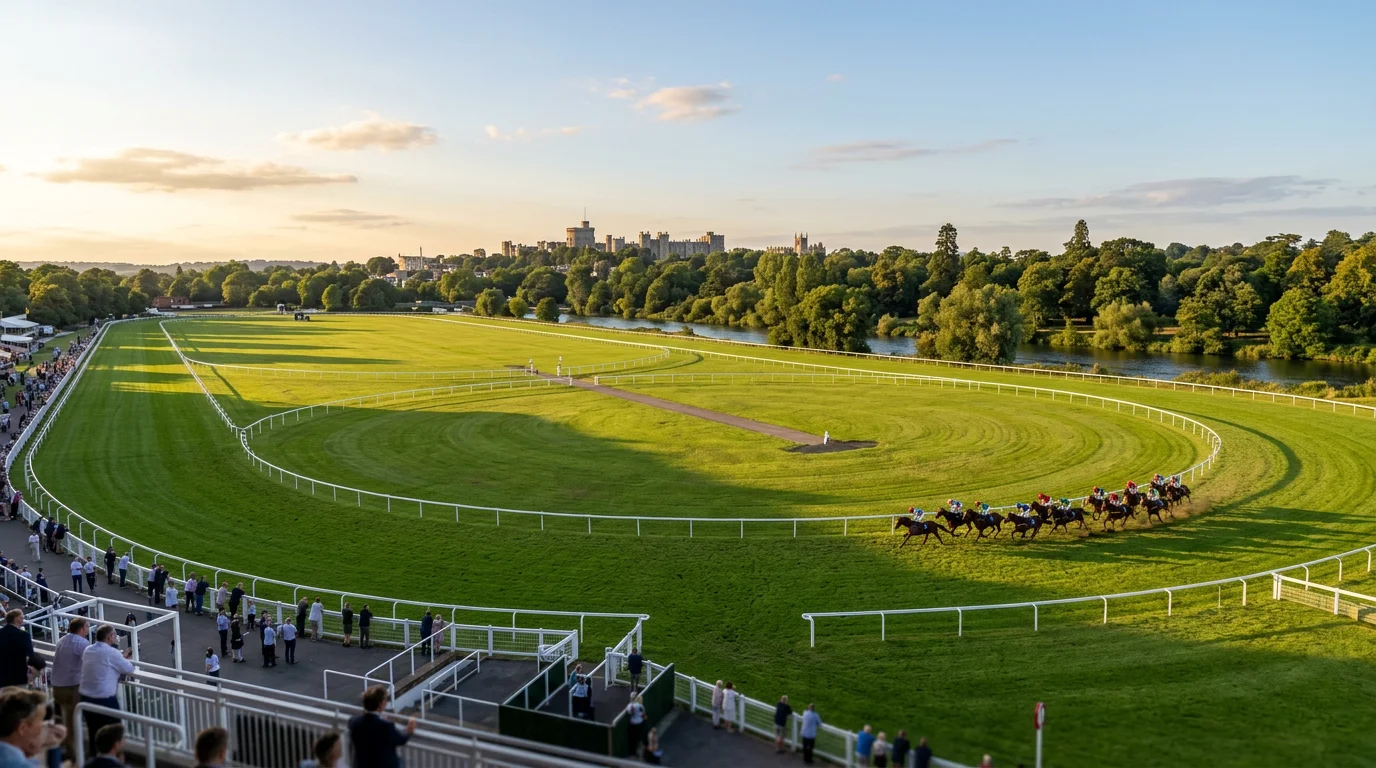
- Where Flat Racing Meets the Figure-of-Eight: A Course Built Unlike Any Other
- The Layout in Detail: Start Points, the Crossing and Camber
- Distance by Distance: What Each Trip Demands
- Going at Windsor: How the Thames Basin Drains
- Evening Racing at Windsor: The Monday Night Routine
- Jump Racing Returns: What Changed in December 2024
- Getting There and Getting In: Practical Details
- What the Course Tells You Before the Racecard Does
Where Flat Racing Meets the Figure-of-Eight: A Course Built Unlike Any Other
Most British racecourses follow a predictable geometry. Left-handed ovals, right-handed ovals, straight miles — the templates are familiar, and so are the strategies that go with them. Windsor does not fit any of these templates. It is one of only two figure-of-eight courses in the United Kingdom, the other being Fontwell Park in West Sussex, and it is the only figure-of-eight used exclusively for flat racing. That distinction is not cosmetic. It shapes draw bias, pace dynamics, camber, and ultimately the way money should be placed on every race run here. Windsor Racecourse Guide — More on this topic at windsor betting.
Tucked onto an island in the Thames at the edge of Windsor town, the course sits under the walls of Windsor Castle and within the portfolio of Arena Racing Company, the largest racecourse operator in Britain. ARC manages 16 venues and accounts for roughly 39% of all British racing fixtures, but Windsor remains one of its more unusual assets — a compact, right-handed track where the runners cross their own path halfway through the race. That crossing point is not a gimmick. It creates genuine shifts in ground advantage depending on where a horse is drawn and how the going reads on race day.
For bettors, the figure-of-eight matters because it introduces variables you will not encounter at Kempton, Sandown or Ascot just up the road. Camber changes direction at the crossover, the rail advantage flips, and the relative merit of a high or low draw shifts with the weather. Understanding the physical course is not optional homework here — it is the foundation that every other angle at Windsor sits on. The average field size across British flat racing stood at 8.90 runners in 2025, according to the BHA Racing Report, and Windsor’s evening cards regularly fall near or just below that figure. In smaller fields, course knowledge carries more weight because there are fewer variables to hide behind.
This guide breaks the course down layer by layer: layout, distances, drainage, evening format, the return of jump racing and the practical details of attending. Each section is designed to give you something you can use next time you open a racecard with a Windsor header at the top.
The Layout in Detail: Start Points, the Crossing and Camber
If you laid a piece of string in the shape of a figure-of-eight on a table, the crossing point would sit roughly in the centre. At Windsor, it does the same — the track crosses itself about halfway along the circuit, just beyond the home turn area. Runners effectively travel along two loops joined at this intersection, and the result is a course where the camber switches direction partway through the race. On the far loop, the ground tilts one way; on the home loop, the opposite. Horses that handle the transition well gain a genuine advantage. Those that struggle with the shift in balance — particularly long-striding types that lean into their turns — can lose lengths without any visible change in effort.
The course is right-handed for races up to a mile and two furlongs, but in longer events — specifically the 1m3f trip — runners also navigate a left-handed bend on the lower loop of the figure-of-eight. Calling it simply “right-handed” is accurate for most of the race programme but understates what is happening underfoot. At a conventional right-handed oval such as Sandown, the camber is consistent around the entire circuit. At Windsor, the camber resets at the crossing. A jockey riding the far loop experiences a different angle of ground from the one they will meet on the home stretch, and this has consequences for how a horse travels into the home straight. Front-runners who find a rhythm on the far loop can sometimes lose that rhythm at the crossover; hold-up horses, arriving later, may handle the transition more smoothly if they are balanced on contact.
Start positions vary by distance. Sprint races over five and six furlongs are run on the straight course, which bypasses the figure-of-eight entirely. Races over a mile and beyond use the round course, with starts positioned so that runners navigate some or most of the figure-of-eight — including the bends and the crossover — before entering the home straight. The practical effect is that draw bias and pace dynamics change not only by distance but by whether the race uses the straight course or the round course.
The home straight is close to five furlongs — long by British standards, and the length is one reason Windsor accommodates galloping types more than the “sharp” label might suggest. However, despite this generous run-in, the tight turns and the camber changes through the figure-of-eight portion still reward front-runners, because a horse making late headway must first negotiate the crossover and the bends before reaching the straight. The practical effect is that ground lost through those sections is not always recovered even with five furlongs of straight to work with, and jockeys who wait too long to commit can find that the leader has used the long run-in to build an unassailable buffer.
One detail that goes overlooked is the width of the track. Windsor is not a wide course. On the bends, the racing line narrows, and in larger fields — anything above ten runners — horses drawn wide can be forced to cover extra ground on both loops. This cost is magnified by the figure-of-eight shape because the wide horse has to absorb camber changes while already running a longer route. In small fields of six or seven, the width matters less. In larger fields, it matters a great deal, and it is one of the reasons draw analysis at Windsor produces more dramatic numbers than at most comparable tracks.
The rail is positioned on the right side, as expected for a right-handed course, but the area of ground near the rail does not always offer the best footing. On days when the going is softer — and Windsor can turn soft quickly after rain — the strip of ground along the inside rail can churn up, pushing the advantage towards runners drawn higher, who can race on fresher ground further from the rail. This interaction between going and draw is covered in depth below, but it is worth noting here that the physical layout creates the conditions for it. Without the figure-of-eight, the camber shifts would not exist, and without the camber shifts, the inside rail would not degrade in the same pattern.
Distance by Distance: What Each Trip Demands
Windsor stages flat races over five furlongs, six furlongs, one mile, one mile and two furlongs, and occasionally one mile and four furlongs. Each trip uses a different portion of the figure-of-eight, and each asks something slightly different of the horse — and of the bettor trying to assess it.
Five Furlongs
The shortest distance at Windsor is a pure speed test. Five-furlong races are run entirely on the straight course, which joins the round circuit at the top of the home straight. Because the run is straight, there is no bend work — but the course is not featureless. There is a slight kink in the track roughly three furlongs from the finish, and the ground can ride differently on the far side compared with the stands side, particularly when the going is soft. The draw is consequently important at this trip: higher-drawn stalls, positioned towards the far rail, often have access to fresher ground, while lower draws race closer to the stands rail. Five-furlong races at Windsor tend to produce decisive results. Margins can be small, and the winners are nearly always those who break well and hold their position through the closing stages. Hold-up sprinters have a poor record here, not because of bends, but because the sprint course’s character rewards early speed and the ability to sustain it.
Six Furlongs
Six-furlong races at Windsor also start on the straight course, joining the round circuit via a chute at the five-furlong marker. Like the five-furlong trip, this is essentially a straight-course race, meaning the bends and crossover do not come into play. The draw dynamics are similar to those at five furlongs but marginally less extreme: higher draws still tend to fare well, particularly on softer ground, but the extra furlong gives jockeys slightly more time to find a position. The pace is still sharp, and the straight-course configuration means that a horse drawn on the wrong side of a split field can lose contact without any obvious tactical error.
One Mile
Mile races use the round course and bring the figure-of-eight layout into play. The start position is on the far side of the track, and runners navigate tight right-handed bends, pass through the crossover area, and enter the long home straight. Draw bias at a mile is weaker than at the sprint distances, according to data from DrawBias.com, and pace becomes a more nuanced factor. A horse can afford to sit further back in a mile race than in a sprint, but it still needs to be travelling well at the crossover to take advantage of the long run-in. The field sizes at a mile are often among the largest on a Windsor card, and that makes the draw marginally more relevant again — the wider a horse is drawn in a field of twelve, the more ground it loses through the bends.
One Mile Two Furlongs and Beyond
The longer distances at Windsor — 1m2f and the occasional 1m3f (the longest trip available, at 1m3f 99y) — are where the figure-of-eight layout has its most complete influence. Runners cover most of the circuit, encountering both right-handed bends and, at 1m3f, a left-handed turn on the lower loop as well — making Windsor one of the few flat courses where runners turn both ways in a single race. The camber changes are felt across a longer period. Draw bias is generally minimal at these distances, and the race tends to be decided more by stamina, class and jockeyship than by starting position. The home straight is close to five furlongs, giving closers more room to operate than at many tight tracks, but front-runners still hold an advantage because the bends and the crossover demand energy that hold-up horses must expend in acceleration. The Winter Hill Stakes, Windsor’s Group 3 feature, is run over 1m2f, and its roll of honour tells you that class and fitness matter more than the draw at this trip — but that horses who race prominently are still favoured.
Across all distances, the national average field size on the flat sits at 8.90 runners for standard fixtures and climbs to 11.02 on Premier days, per the BHA’s 2025 data. Windsor’s typical evening cards track close to the standard figure, which means that most races here carry enough runners for the draw to be a factor but not so many that it overwhelms every other variable.
Going at Windsor: How the Thames Basin Drains
Windsor sits on low-lying ground beside the Thames, and that geography defines the going more than at most flat courses in the south of England. The water table here is naturally high. After heavy rain, the course can shift from good to soft in a matter of hours, and it does not always dry back evenly. The figure-of-eight layout complicates matters further: the crossing point and the areas immediately around it tend to hold moisture longer than the rest of the track, because the ground there is subject to more foot traffic from runners covering both loops.
The drainage at Windsor has been improved over the years, but the fundamental position beside a major river imposes limits. On summer evenings, when the going is firm or good to firm, the course rides as fast as any flat track in the region. The bends are manageable, the camber is firm underfoot, and speed horses thrive. But when the heavens open — and they do, often enough during the British summer — the course can turn testing within a single card. It is not unusual for the going to be officially described as “good” at the first race and “good to soft” by the fifth.
For bettors, the going at Windsor interacts directly with draw bias. On good or faster ground, draw differences are relatively small — pace matters more than starting position, and a horse with natural speed can overcome a slightly unfavourable stall. On softer going, the picture changes. Data from HorseRacingBettingSites.co.uk shows that soft conditions amplify the advantage of higher-drawn stalls at five and six furlongs. The reason is straightforward: when the inside rail becomes churned and heavy, horses drawn low are forced to run through deeper ground, while those drawn high can race on fresher, less damaged turf further off the rail. The figure-of-eight makes this worse, because the inside rail degrades faster at the crossover where the track surface absorbs the most traffic.
Checking the going report before a Windsor meeting is essential, but checking it once is not enough. If there is rain in the forecast, the ground can shift during the card, and races later in the evening may ride differently from those at the start. The official going report is published by the course clerk and updated on the Windsor Racecourse website, typically within an hour of the first race. Stick testing times are also published on race day and give a more granular picture of where moisture is sitting on different parts of the track.
Evening Racing at Windsor: The Monday Night Routine
Windsor is synonymous with Monday evenings. While other courses scatter their fixtures across the week, Windsor has carved out a niche as the Monday night flat meeting — a fixture list that gives the course a regular rhythm and gives bettors a predictable schedule to build around. The course hosts 26 fixtures in 2026, of which 22 are flat meetings and four are over jumps, according to the official fixture announcement.
A typical Windsor evening card comprises six or seven races, beginning around 5:30pm and finishing before 9pm. That compact format has implications for staking. You are working through a full card in three and a half hours, with relatively short gaps between races — usually around twenty minutes. There is not much time to reassess between races, so the premium is on preparation done before the first. Bettors who study the card in advance, locking in their selections and staking plan before arriving or logging in, tend to do better than those who react on the fly.
The Monday slot also affects the quality of runners. These are not Premier fixtures — Windsor’s flat cards sit at the Core level, which means smaller prize pots and, on average, slightly weaker fields than you would find at Ascot, Newbury or York on a Saturday afternoon. That is not a drawback for the bettor. Core fixtures attract more exposed, more formful horses. The form lines are often more reliable because you are dealing with horses that have run regularly at this level, rather than lightly raced improvers stepping into the unknown. Handicaps dominate the Windsor card, and handicaps reward the bettor who can read recent form and class indicators accurately.
The evening atmosphere at Windsor is its own draw. Attendance across British racecourses has been climbing, with the Racecourse Association reporting that first-half 2025 figures rose 5.1% year on year. “Racecourses are fighting hard to maintain the sport’s position as the second most attended in Britain, and these attendance numbers are a clear sign that our efforts are having a positive effect,” the RCA stated. Windsor benefits from its location — close to London by rail, with easy access from the M4 corridor — and from the informal feel of a summer evening meeting. The crowd skews younger and more casual than at a weekend fixture, which means the on-course betting ring can occasionally offer value that the exchanges miss, particularly in the earlier races before the professional money has settled in.
Jump Racing Returns: What Changed in December 2024
For two decades, Windsor was flat-only. Jump racing had been part of the course’s history — the track has staged races since 1866, and for much of its life it hosted both codes — but the national hunt fixtures were dropped in December 1998 as the course focused on preserving the turf for its summer flat programme. That changed in December 2024, when Windsor staged its first jump meeting in over twenty years, aside from briefly hosting some of Ascot’s fixtures during its mid-2000s refurbishment. The return of jumps racing was not a tentative experiment. It came with a headline event attached.
The Berkshire Winter Million, held over three days in January 2025 in partnership with Ascot, drew 13,170 spectators and offered a prize fund of £1.2 million. The marquee race, the Fitzdares Fleur De Lys Chase — previously run at Lingfield as part of that venue’s Winter Million — was won by Protektorat, trained by Dan Skelton and ridden by Harry Skelton, in a performance that left no room for argument: the winner crossed the line 23 lengths clear of runner-up Djelo. Protektorat had finished second in the same race at Lingfield the year before, and this emphatic victory at Windsor generated the kind of attention that a standalone Windsor flat fixture rarely attracts outside of the Winter Hill Stakes.
For 2026, the prize fund has been raised to £1.25 million. The course now hosts four jump fixtures alongside its 22 flat meetings, and the intent is clear: Windsor wants to be a year-round venue, not just a summer one. The addition of winter fixtures also means that the course surface will be used differently. Jump racing takes a heavier toll on ground than flat racing — larger fields, heavier horses, obstacle landings — and this may have longer-term effects on the going in the early part of the flat season. Bettors who specialise in the flat programme at Windsor should keep an eye on the ground recovery between the final winter fixture and the first flat card of the year.
The figure-of-eight layout works differently for jump racing than for flat. The crossover, which creates camber shifts that affect speed horses over five furlongs, presents different challenges for jumpers. The angle of approach to fences at certain points on the circuit is unusual, and jockeys at the inaugural meeting noted that the track rode differently from what they expected based on the flat configuration. This is still new territory — there is not yet enough data to make strong claims about jump racing bias at Windsor — but the early evidence suggests that the figure-of-eight shape will produce its own set of betting quirks on the national hunt side, just as it does on the flat.
Getting There and Getting In: Practical Details
Windsor Racecourse sits a short walk from Windsor and Eton Riverside station, which is served by regular trains from London Waterloo — a journey of under an hour. By road, the course is just off the M4 at Junction 6, and parking is available on site, though it fills up on busier cards. There is also the distinction of being the only racecourse in Britain accessible by river: boat services from central Windsor and upstream towns drop visitors close to the entrance, a feature that sounds novelty but is genuinely used during summer meetings.
Admission is divided between enclosures. The Grandstand and Paddock offers the best views of the finishing straight and access to the parade ring. The Windsor Enclosure is a more relaxed option with lower admission prices and a decent view of the final furlong. Both enclosures have Tote windows and on-course bookmakers. Prices vary by fixture, with the Berkshire Winter Million and any Premier-level summer cards commanding higher gates than a standard Monday evening.
On-course bookmakers at Windsor typically line the betting ring in the Grandstand enclosure. Their prices are worth checking against the exchanges and fixed-odds providers, particularly in the first two races of the card, when the ring is still forming its prices and the market can be slightly less efficient than later in the evening. The Tote operates at every meeting, and the Placepot — a six-race pool bet — tends to carry a decent pool at Windsor because the compact card format means all Placepot legs are run within a single evening. For those who prefer to bet online, all major UK-licensed bookmakers cover Windsor meetings with full fixed-odds and each-way markets.
Food and drink options have been upgraded in recent seasons, with several hospitality packages available for evening meetings. None of this is essential for the bettor, but it is worth knowing that the facilities are significantly better than they were five years ago. Windsor has invested in the on-course experience as part of a broader push to attract younger racegoers — a trend visible across British racing, where under-18 attendance rose by 17% in 2025.
What the Course Tells You Before the Racecard Does
Every racecourse in Britain has its quirks, but Windsor’s are structural rather than cosmetic. The figure-of-eight layout creates camber changes that affect races run on the round course. The tight bends before the long home straight reward horses that travel smoothly through the crossover. The Thames-side drainage means the going can shift during a single card, and when it does, the draw bias shifts with it. Sprint races, run on the straight course, are shaped by a different set of factors — ground conditions across the width of the track, draw side preferences in splits — that do not feature at other Windsor distances. None of these factors appear on the racecard. You will not see “crossover camber disadvantage” listed next to a horse’s name, and no form guide tells you that the far-side ground is riding faster. These are things you learn from knowing the course.
The return of jump racing adds another dimension. Windsor is no longer a flat-only venue, and the winter fixtures bring different ground conditions, different audience profiles and different betting dynamics. The Berkshire Winter Million has already established itself as a fixture worth paying attention to, both as a spectacle and as a betting event. How the course manages the transition between jump season and flat season — particularly in terms of ground recovery — will be worth monitoring over the coming years. See also Windsor Draw Bias Explained.
What this guide should leave you with is a layered understanding of the track. Not just “right-handed, figure-of-eight” — that much you could get from any form book — but a sense of how the layout interacts with distance, going, pace and position to produce outcomes that are, to a degree, predictable. The course is a variable, and like any variable, it rewards the bettor who accounts for it properly. The racecard tells you who is running. The course tells you who has the advantage before the stalls open.
