
 Available in US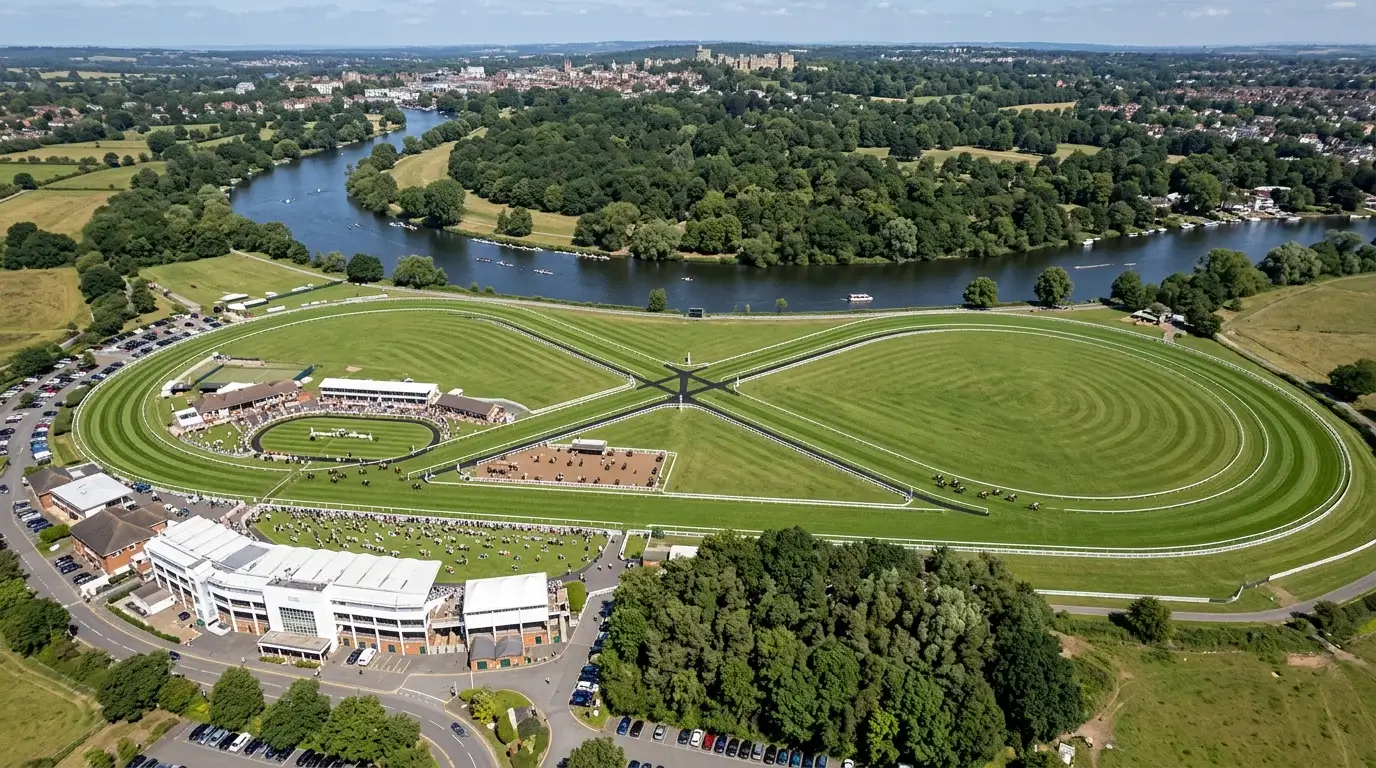
Only Two Courses in Britain Cross Themselves — Here’s What That Looks Like at Windsor
Of the sixty-odd racecourses operating in Britain, only two are configured as a figure-of-eight: Fontwell Park and Windsor. Both involve the track crossing over itself at some point during the race, but the similarity largely ends there. Fontwell is a National Hunt course in West Sussex; Windsor is primarily a flat track in Berkshire. The two figure-of-eights produce entirely different racing dynamics, and understanding Windsor’s specific geometry — where the track bends, where it crosses, and where it tilts — is the starting point for any serious analysis of form at this venue. Windsor Course Map — More on this topic at windsor betting.
Windsor is also the only racecourse in Britain situated on an island — a narrow strip of land between the Thames and the Clewer Mill Stream. That geography constrains the layout: the designers could not simply build a conventional oval, because the available land was not wide enough. The figure-of-eight was an engineering solution as much as a design choice, and it gives the course characteristics that no amount of description can fully replace. This walkthrough maps the course section by section, from the crossing point to the home straight, with the aim of putting a picture in your head before you ever look at a racecard.
The Crossing Point: Where Two Paths Meet and Camber Shifts
The defining feature of any figure-of-eight is the intersection — the point where the track crosses over itself. At Windsor, this crossing sits roughly in the centre of the layout, between the two main loops. Runners pass through it at least once and in some longer races twice, depending on the distance.
The crossing point is not a flat junction. The two arms of the track are at slightly different levels where they intersect, which means horses experience a subtle but noticeable change in gradient as they pass through. The surface at the crossing receives more traffic than any other part of the course, because every race at every distance sends its field through this section. On soft ground, the crossing point can ride heavier than the rest of the track — a detail that matters for horses on the inside rail, who pass through the most worn strip.
For bettors, the crossing point’s significance is less about the physical feature itself and more about what it does to the field. Horses that are unsettled by changes in gradient or camber — and some are — can lose rhythm at the crossing. Jockeys who know the course will adjust their position in advance, holding a line that minimises the disruption. First-time visitors to the course, both equine and human, may not. Previous course form at Windsor is disproportionately valuable partly because of this crossing: a horse that has handled it well before is more likely to do so again, while a debutant at the track faces an unknown variable that the form book cannot capture.
The crossing also creates a visual oddity for spectators and TV viewers. Because the two arms of the track overlap, runners can appear to be heading in opposite directions simultaneously. This makes following the action from the stands slightly more complex than at a conventional course, and it means that in-running betting — where you react to the visual position of the field — requires familiarity with the layout. Watch two or three races from the stands or on a screen before placing an in-running bet; the first time you see the field cross the intersection, you will understand why.
Start Positions by Distance: Where Each Race Begins
Windsor runs flat races from five furlongs to one mile four furlongs, and each distance starts from a different point on the track. Knowing where the start is for each trip tells you which sections of the course the field will encounter and — critically — how far the first bend is from the stalls.
At five furlongs, the start is on a straight section that feeds quickly into the first right-handed bend. The run to the turn is short, which is why the draw has such a pronounced effect at this trip: horses drawn wide have less time to find a position before the bend compresses the field. The race runs through one loop of the figure-of-eight and finishes on the home straight.
At six furlongs, the start is further back, giving runners a slightly longer straight before the first bend. The additional furlong also means the field negotiates a different section of the figure-of-eight, and the racing line from the stalls to the first turn favours a different set of draw positions. The distinction between five and six furlongs at Windsor is not merely one of distance; it is one of geometry.
At one mile, the stalls are positioned so that the field runs through the full figure-of-eight, including the crossing point. The longer run to the first bend gives jockeys more time to settle and find position, which is one reason the draw bias weakens at a mile — there is simply more track available to compensate for a wide berth. With the national average flat field at 8.90 runners and Windsor mile fields often slightly smaller, the starting width is manageable and traffic problems are less acute than in sprint races.
At 1m2f and 1m4f, the start moves further around the course, and the field covers a larger proportion of the figure-of-eight. These longer trips neutralise draw bias almost entirely. The crossing point is encountered earlier in the race, when the field is still bunched, and the finishing straight — the same for all distances — is reached after a series of turns that reward horses who travel efficiently through bends. A free-moving horse with a good cruising speed gains a tangible advantage over these trips, regardless of its starting position.
Turn Geometry: Right-Handed Bends and the Home Straight
Windsor is a right-handed track throughout. Every bend turns to the right, and horses racing on the inside rail save ground on every turn. The bends are relatively tight by flat racing standards — tighter than Newmarket’s wide sweeps or Ascot’s gradual curves, though not as sharp as the turns at Chester. The tightness rewards balanced, well-schooled horses and penalises those who lean or drift on turns, losing ground with every stride.
The camber — the lateral tilt of the track surface on bends — is present but not extreme. It tilts inward on right-handed turns, as you would expect, helping horses maintain their line. On soft ground, the camber can work against low-drawn horses on the inside rail if the ground there is more cut up, because the tilt channels water towards the inside. This is one of the mechanisms behind the soft-going draw effect noted in the broader bias data: the inside rail rides heavier on soft days, and the camber ensures the drainage flows in that direction.
The home straight at Windsor is shared across all distances — every race finishes along the same stretch, regardless of where it started. The straight is not long by flat-course standards. Horses that make their challenge early — from two furlongs out rather than one — tend to fare better, because the short run-in does not give late closers enough time to overhaul front-runners. This ties directly into Windsor’s dominant pace bias: the track geometry favours those who race prominently and challenge early, not those who sit at the back and hope for a gap in the final furlong. See also How Ground Conditions Affect Racing at Windsor.
Reading the Course Before Reading the Card
The course that crosses itself rewards the bettor who understands its geometry. Before assessing form, draw, or trainer patterns, picture the race: where the stalls are, how far the first bend is, whether the field will pass through the crossing point, and how the home straight favours early challengers. That spatial awareness — knowing what the track demands before you ask what the horse offers — is the foundation of every Windsor-specific angle. The racecard tells you about the runners. The course map tells you about the race itself.
